
- Turnkey Powder Coating Solutions: How to Avoid Hidden Costs and Project Delays
- Best Powder Coating Line Configuration for Factories: How to Match Equipment to Production Needs
- How to Compare Different Powder Coating Line Quotations
- High-Efficiency Powder Coating Systems for Industrial Metal Products
- How to Design a Spray Painting Line for Different Metal Parts
phone:+8618533267656
WhatsApp:+8618032661886
Email:info@powder-coatingline.com
Address:No. 55, Airport Road, Changshou Street, Xinle City, Shijiazhuang, Hebei Province
Best Powder Coating Line Configuration for Factories: How to Match Equipment to Production Needs
A powder coating line should be configured around the factory's production requirements, not around a standard list of equipment. Two factories coating similar metal products may need very different systems because their output targets, product mix, available space, and color change frequency are different.
For one factory, a manual powder coating booth and a batch curing oven may be the most practical starting point. For another, a conveyorized line with automatic spray guns and a dedicated powder recovery system may be necessary to maintain production output.
The important decision is not how much equipment to automate. It is which configuration can meet the required production rate and coating quality without creating unnecessary operating costs or limiting future production.
Start With the Product Mix, Not the Equipment List
Before requesting quotations, identify the products the line must handle.
Record the maximum workpiece dimensions and weight, the materials being coated, the required finish, and the expected production volume. Also consider whether the factory produces a few standardized products or a wide variety of parts in different sizes.
These details influence several parts of the line at the same time.
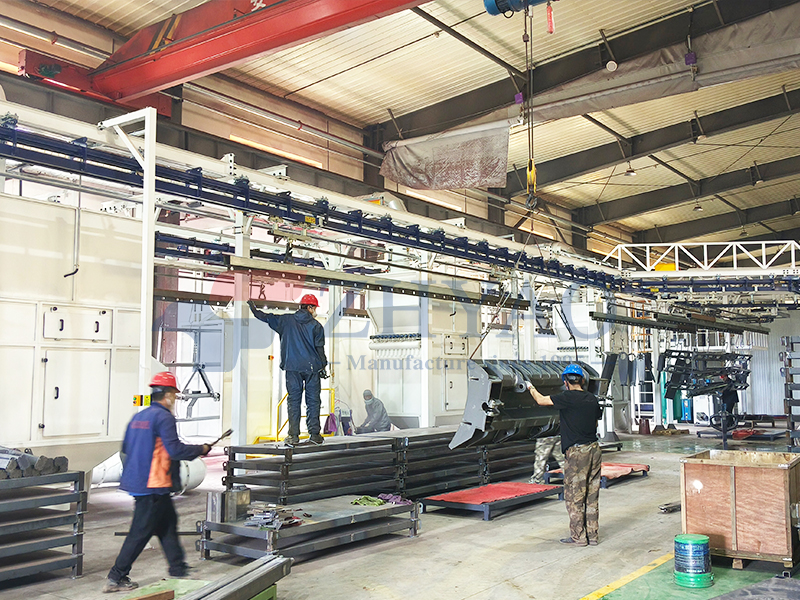
Large or heavy workpieces may require stronger hangers, greater conveyor loading capacity, and more space between parts. Products with deep recesses or complex geometries may require special attention to grounding, spray gun positioning, and coating coverage. If the product mix changes frequently, the line must accommodate different loading arrangements and production schedules.
A configuration designed around one representative workpiece may not perform well when the factory begins processing its largest, heaviest, or most difficult products.
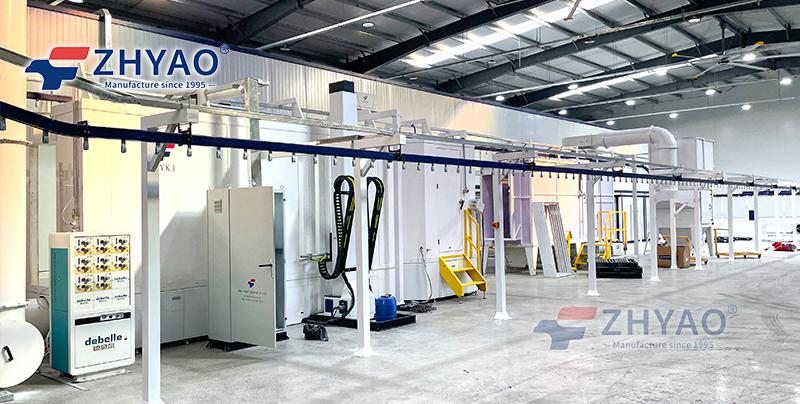
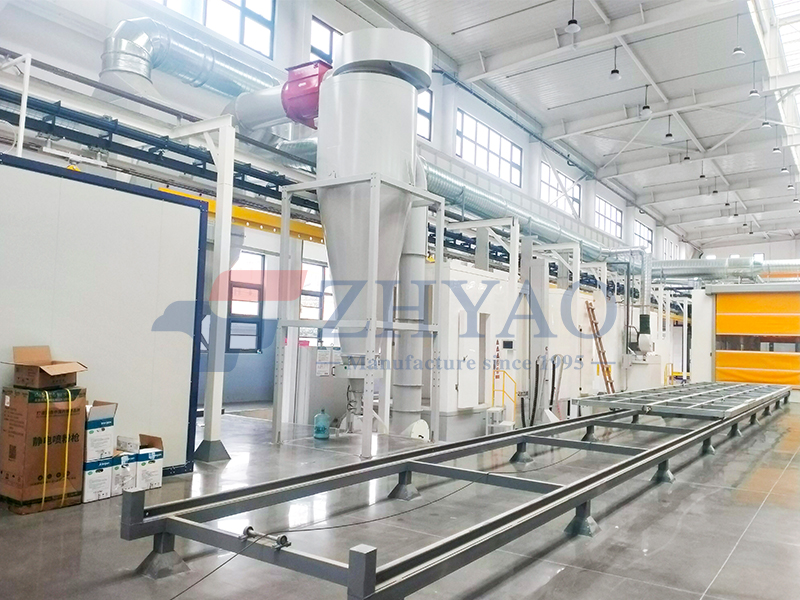
(On-site view of the ZHYAO powder coating line project for electrical cabinets in Mongolia.)
Choose the Production Layout That Fits the Factory's Output
The first major configuration decision is whether to use batch production or a continuous conveyorized line.
Batch Powder Coating Lines for Flexible Production
A batch configuration typically uses a manual spray booth, a batch curing oven, and suitable workpiece handling equipment. Depending on the process, it may also include pretreatment and drying equipment.
This arrangement suits factories with relatively low or variable production volumes, frequent product changes, or large workpieces that are difficult to handle on a conventional conveyor.
Its main advantage is flexibility. Operators can process different products and organize production around available orders without maintaining a constant conveyor flow.
The trade-off is labor and scheduling. Loading, unloading, moving workpieces between process stages, and managing oven batches can become bottlenecks as output increases. Oven capacity also depends on how the parts are arranged and whether the load can be heated uniformly.
A batch line is therefore not simply a smaller version of an automatic line. It is a different production arrangement that works best when flexibility matters more than continuous throughput.
Conveyorized Powder Coating Lines for Repeatable Production
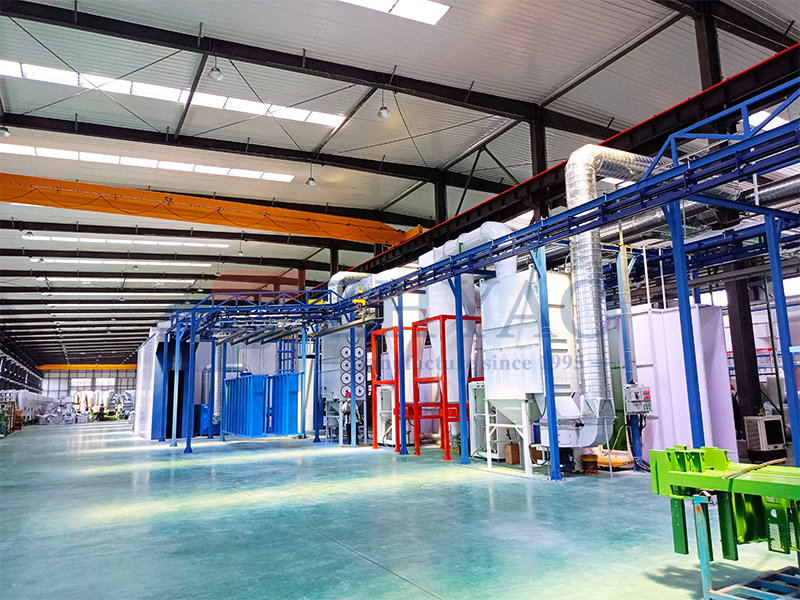
A conveyorized configuration links workpiece loading, pretreatment, drying, powder application, curing, and unloading into a coordinated process.
It is generally more suitable when factories process repeatable products at relatively stable volumes. The conveyor establishes a production rhythm, reduces repeated manual transfers, and allows different process stages to operate in sequence.
However, conveyorization creates its own constraints. Conveyor speed, hanger spacing, workpiece size, spray booth capacity, and curing performance must be matched. If the curing oven requires a longer residence time than the planned conveyor arrangement allows, increasing the conveyor speed to meet an output target may compromise curing.
The line must also accommodate maintenance, product changeovers, and variations in the production schedule. A continuous line can be highly productive, but it is not automatically the most economical choice for a factory with small, irregular orders.
Configure Pretreatment According to the Required Coating Performance
Pretreatment should be selected according to the substrate, incoming surface condition, coating specification, and expected service environment.
For some products, mechanical cleaning such as shot blasting may be appropriate. Other applications may require chemical cleaning, rinsing, and a suitable conversion coating before powder application. The correct route depends on the material and the required corrosion resistance and adhesion performance.
The equipment configuration should reflect that requirement.
A chemical pretreatment system may include several treatment stages, rinsing stages, and a drying process. The number and arrangement of stages depend on the selected chemistry, product geometry, contamination level, and process control requirements.
A factory coating clean, lightly contaminated metal parts may not need the same pretreatment arrangement as a factory processing oily steel components for demanding outdoor service.
Adding treatment stages without a clear technical reason increases equipment cost, space requirements, chemical consumption, and wastewater management needs. Removing necessary treatment stages can lead to adhesion or corrosion problems that cannot be corrected simply by increasing powder film thickness.
Pretreatment is therefore a specification decision, not an accessory to be added after the main equipment has been selected.
Size the Curing Oven Around the Actual Workpieces
The curing oven is one of the most consequential parts of a powder coating line because it affects both coating performance and production capacity.
The oven must provide the curing conditions specified for the selected powder. The relevant temperature is the actual workpiece metal temperature, not just the oven air temperature.
A thin sheet metal component may heat up relatively quickly, while a heavy casting or thick welded assembly may require considerably more time to reach the required metal temperature. Workpiece loading, geometry, airflow, and the oven's heating performance also influence the result.
For a conveyorized line, the required residence time helps determine the effective heated length at the planned conveyor speed. For a batch line, the oven must accommodate the workpiece arrangement and the time needed for the load to reach the specified curing conditions.
Oversizing the oven can increase capital cost, floor space, and energy demand. Undersizing it can restrict output or prevent the coating from receiving the required cure.
The right approach is to establish the powder's curing schedule, identify the most demanding workpiece, and verify the heating performance before finalizing oven dimensions.
Decide How Much Powder Application Should Be Automated
Automation should be selected according to production repeatability, labor availability, coating complexity, and the consistency required from one workpiece to the next.
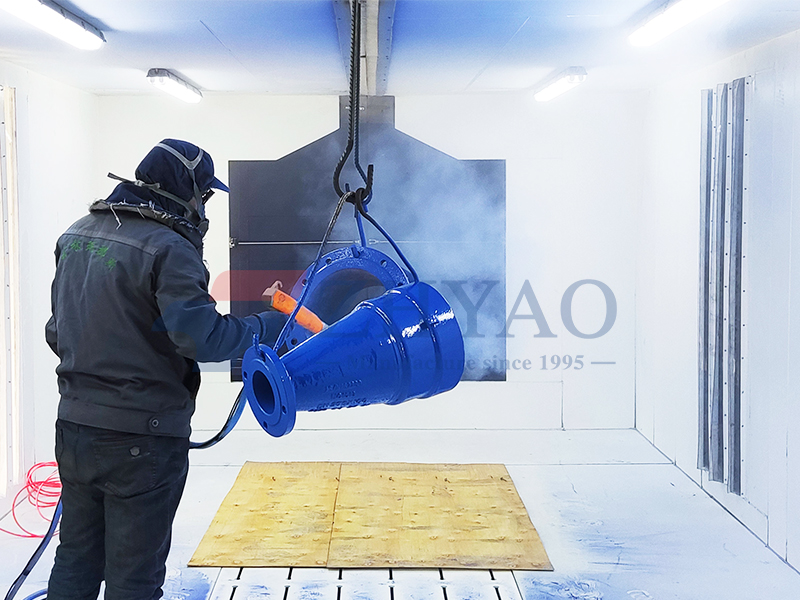
A manual spray booth offers flexibility for varied products and lower production volumes. It also allows operators to adjust their technique for complex shapes, provided they have the necessary skill and process controls.
Automatic spray guns and reciprocators can improve repeatability when products follow a relatively consistent path and require repeated coating operations. They are particularly useful when the same product family is processed regularly.
However, automatic spraying does not eliminate the need for correct workpiece grounding, suitable gun positioning, appropriate spray settings, and manual attention to difficult areas where necessary. Complex geometries may require a combination of automatic and manual application.
A robotic system may be appropriate when product geometry, motion requirements, and production demands justify the additional programming, integration, and maintenance. It is not necessarily the best choice for every factory producing metal parts.
The key question is whether automation addresses a real production constraint. If manual loading is the bottleneck, automating the spray guns alone may not deliver the expected increase in output. If the product mix changes constantly, a highly specialized automatic setup may create additional changeover work.
Design Powder Recovery Around Color Changes
Powder recovery is closely connected to booth design and production planning.
When a factory runs large batches of the same color, reclaiming suitable overspray can reduce powder waste. The recovery system must still maintain the required coating quality and prevent contamination.
Frequent color changes create a different problem. Cleaning the booth, guns, powder delivery components, and recovery equipment takes time. Residual powder can contaminate the next color, particularly when appearance requirements are strict.
Factories with stable color schedules may benefit from a configuration optimized for efficient recovery. Factories processing many colors in small batches may place greater value on rapid cleaning, accessible components, and a suitable quick-color-change arrangement.
Dedicated booths may be justified for high-volume or special-effect colors, but they require additional capital and floor space. A quick-change booth may reduce changeover time, although its actual benefit depends on the complete cleaning and powder handling process.
The right configuration should be based on the production schedule, not on powder recovery efficiency alone.
Compare Three Practical Configuration Levels
The following options illustrate how a factory might approach configuration. They are starting points for project evaluation, not universal equipment packages.
1. Flexible batch configuration
Typical arrangement: manual powder coating booth, batch curing oven, workpiece handling equipment, and pretreatment appropriate to the substrate and coating requirements.
Best suited to: variable production, frequent product changes, low or moderate throughput, and factories handling products that are difficult to convey continuously.
Main trade-off: lower integration requirements and greater flexibility, but more manual handling and potentially lower output per labor hour.
2. Semi-automatic conveyorized configuration
Typical arrangement: conveyor system, suitable pretreatment and drying equipment, powder coating booth with a combination of manual and automatic application where appropriate, curing oven, and a recovery system matched to the color schedule.
Best suited to: growing factories with repeatable product families and enough production volume to benefit from coordinated process flow.
Main trade-off: improved process coordination and reduced repeated handling, but more complex line balancing and greater dependence on conveyor availability.
3. Highly automated configuration
Typical arrangement: integrated conveying, automated pretreatment and drying where required, automatic powder application, suitable recovery and color management, curing oven, and coordinated controls.
Best suited to: stable, high-volume production where product repeatability and labor productivity justify the investment.
Main trade-off: greater capital expenditure, more demanding integration and maintenance, and potentially more expensive changeovers when the line is designed around a narrow product range.
The correct choice depends on the factory's actual operating conditions. A semi-automatic line can be more economical than a fully automatic system when product variety is high or utilization is uncertain.
Calculate the Required Output Before Approving the Layout
Production capacity should be established before equipment dimensions and conveyor speed are finalized.
For a conveyorized line, a simplified estimate is:
Required output per hour = Target output per shift ÷ Available production hours per shift.
If a factory needs to coat 1,200 parts during an eight-hour shift, the average target is 150 parts per hour. This is a planning target, not a guaranteed line capacity. Breaks, maintenance, loading delays, rejected parts, and color changes can reduce effective output.
For a conveyor carrying multiple workpieces per hanger, the required hanger frequency also depends on the number of parts per hanger and the usable operating time.
The estimate must then be checked against the slowest critical stage. Pretreatment, drying, spraying, curing, loading, and unloading cannot be treated as independent capacities. If one stage cannot sustain the required flow, the entire line may be limited by that stage.
For batch production, calculate the number of usable parts per oven load, the complete batch cycle time, and the available operating time. Include loading, unloading, heating, curing, and any required cooling or transfer time.
These calculations help reveal whether the factory needs a different layout, more oven capacity, additional handling resources, or simply a more realistic production target.
What to Confirm Before Requesting a Quotation
A useful quotation request should give suppliers enough information to design a comparable system.
Prepare the following information:
Workpiece materials, dimensions, maximum weight, and representative product drawings or photographs.
Expected output per shift and the number of operating shifts.
Product variety, batch sizes, and color change frequency.
Required coating appearance, film thickness, corrosion resistance, and applicable specifications.
Incoming surface condition and pretreatment requirements.
Available factory space, building height, utilities, and site restrictions.
Desired automation level, available labor, and plans for future production changes.
Ask each supplier to identify the assumed production conditions, major equipment, process route, expected capacity, and items excluded from the quotation.
This is especially important when comparing prices. A lower quotation may reflect a simpler pretreatment arrangement, a different conveyor configuration, less automation, or a curing oven designed around a different loading assumption. The difference is not necessarily a disadvantage, but it must be understood before the proposals can be compared fairly.
The best powder coating line configuration is the one that meets the factory's verified production and coating requirements at a reasonable total operating cost. It is not necessarily the largest, most automated, or most expensive system.
FAQ
What equipment is needed for a complete powder coating line?
A typical line may include pretreatment and drying equipment, a powder coating booth, powder application equipment, a curing oven, a conveyor or batch handling system, and suitable controls. The exact configuration depends on the substrate, coating requirements, production volume, and product mix. Not every factory needs the same pretreatment stages or automation level.
Is a fully automatic powder coating line always better than a semi-automatic line?
No. A fully automatic line can improve repeatability and labor productivity when production volume is stable and products follow consistent process conditions. A semi-automatic line may be more economical when product variety is high, batches are small, or frequent adjustments are required. The decision should account for utilization, labor, changeover time, maintenance, and the cost of the complete system.
- Previous:How to Compare Different Powder Coating Line Quotations
- Next:Turnkey Powder Coating Solutio



 customer service