
- How to Compare Different Powder Coating Line Quotations
- High-Efficiency Powder Coating Systems for Industrial Metal Products
- How to Design a Spray Painting Line for Different Metal Parts
- Overhead Conveyor or Floor Conveyor for Heavy Workpieces: Which Should You Choose?
- How Factory Space and Layout Affect Powder Coating Line Design
phone:+8618533267656
WhatsApp:+8618032661886
Email:info@powder-coatingline.com
Address:No. 55, Airport Road, Changshou Street, Xinle City, Shijiazhuang, Hebei Province
High-Efficiency Powder Coating Systems for Industrial Metal Products
An efficient powder coating system for industrial metal products must balance production output, coating quality, and operating costs. Increasing conveyor speed or installing more automatic spray guns does not necessarily improve overall productivity if another process becomes a bottleneck.
For manufacturers of metal cabinets, machinery components, steel frames, aluminum parts, and other industrial products, the right system configuration depends on workpiece characteristics, production volume, coating requirements, and the time required for each process.
The key is to design the system around the actual production workload rather than selecting equipment based on individual specifications alone.
1. Define What Efficiency Means for Your Production
Before comparing powder coating systems, establish what the factory needs to improve.
A manufacturer with insufficient output may need greater processing capacity. A factory experiencing frequent coating defects may need better spray coverage or more reliable curing conditions. Another manufacturer may be losing production time through manual handling, color changes, or frequent adjustments between product types.
These problems require different solutions. Increasing automation will not necessarily resolve a curing bottleneck, and installing a larger spray booth will not solve inconsistent workpiece positioning.
A useful starting point is to identify the main production constraint and measure its effect on finished output, rework, labor, or downtime.
For purchasing decisions, this distinction matters because the most cost-effective system is not always the one with the greatest nominal capacity. It is the one that addresses the factory's actual production limitations.
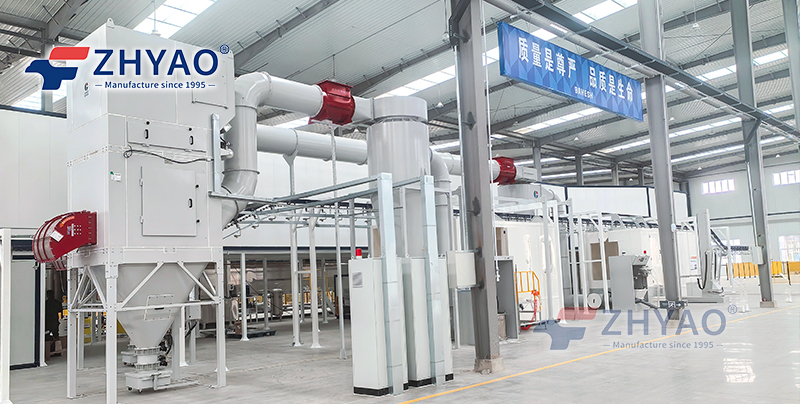
2. Match System Capacity to the Products Being Coated
Workpiece dimensions, weight, and geometry influence how many products can be processed and how consistently they can be coated.
Large steel frames or machinery housings may require greater clearance and more space between consecutive workpieces. Smaller components may allow closer spacing, provided that spray access and coating quality are maintained.
Complex products can create a different challenge. Recessed areas, narrow gaps, and irregular surfaces may require additional spray coverage or more careful positioning. As a result, a product with a smaller overall size may take longer to coat than a larger part with a relatively simple shape.
These differences affect conveyor loading, fixture design, spray gun arrangement, and achievable production output.
When requesting a quotation, provide suppliers with representative product drawings or samples, the minimum and maximum workpiece dimensions, weight ranges, and the expected production volume of each product type. If one line must handle several products, explain how frequently the product mix changes.
This information helps determine whether a shared production line is practical and what adjustments may be required.
3. Identify the Bottleneck Before Increasing Production Speed
The output of a powder coating line is limited by the process that cannot keep pace with the rest of the system.
For example, increasing conveyor speed may allow more workpieces to enter the spray booth each hour. However, if the spray arrangement cannot provide the required coverage at that speed, coating quality may deteriorate. If the curing oven cannot accommodate the revised production conditions, the additional throughput may not translate into more acceptable finished products.
Loading and unloading can also restrict output, even when the coating equipment itself has sufficient capacity.
Before upgrading a system, evaluate the relationship between conveyor speed, workpiece spacing, spraying time, curing requirements, and material handling. The objective is to determine which limitation has the greatest effect on actual production.
This is also an important distinction when comparing suppliers. A proposed line should be assessed against the required finished output and the operating conditions used to calculate that output, not simply against a stated conveyor speed.
4. Configure Powder Application Around Coating Quality
The efficiency of powder application depends on more than the number of spray guns installed.
Automatic spray guns can provide repeatable coverage on suitable products, particularly when workpiece dimensions and production conditions remain relatively consistent. However, the position and angle of each gun, the orientation of the workpiece, and the geometry of the surfaces all affect powder deposition.
Recessed areas and complex profiles may receive less powder than exposed surfaces. Adding more guns without addressing these conditions can increase powder consumption without resolving the coverage problem.
For factories producing a variety of industrial metal components, the system may require adjustable gun positions, suitable fixtures, or supplementary manual spraying for difficult areas.
The appropriate arrangement depends on the required finish, product geometry, powder characteristics, and production volume. Before finalizing the configuration, clarify which surfaces need coating and whether representative workpieces can be used to evaluate coverage.
Consistent application helps reduce avoidable rework and makes production performance more predictable.
5. Make Sure the Curing Process Can Support the Required Output
Curing capacity must be evaluated alongside spraying capacity.
The time and temperature required for curing depend on the powder manufacturer's specifications and the actual thermal conditions experienced by the workpiece. Metal parts with different thicknesses, masses, and geometries may heat at different rates under the same oven conditions.
For example, a heavy steel component may require a different heating profile from a thin sheet-metal part. If both products share a production line, the proposed curing process must accommodate their requirements without compromising coating performance.
A higher conveyor speed is not a valid productivity improvement if it prevents the workpieces from receiving the required curing conditions.
When reviewing a proposed system, confirm how the oven capacity is matched to the intended workpieces and production rate. Where necessary, curing performance should be evaluated by measuring workpiece temperature and verifying the required time at temperature, rather than relying on oven air temperature alone.
6. Choose Automation Based on Production Volume and Product Variation
Automation can improve repeatability and reduce manual workload, but the benefits depend on the production pattern.
Factories producing large quantities of similar parts may benefit from automatic spraying and conveyorized handling because the equipment can operate under relatively consistent conditions. Manufacturers processing many different product types may need more time for fixture changes, spray gun adjustments, cleaning, and program changes.
In these situations, flexible automation or a combination of automatic and manual spraying may be more practical than a fully automatic arrangement designed around a narrow product range.
The investment decision should consider the expected reduction in labor and rework, together with the additional costs of equipment, maintenance, programming, and changeovers.
The objective is not to automate every operation. It is to identify which operations benefit sufficiently from automation to justify the investment.
7. Compare Total Operating Requirements, Not Just Equipment Prices
Two powder coating systems with similar production targets may have different initial costs and long-term operating requirements.
A meaningful comparison should consider equipment scope, installation, labor, energy consumption, powder utilization, maintenance, cleaning, and production downtime.
Powder recovery can reduce material waste, but the actual benefit depends on the recovery configuration, powder characteristics, and color-change practices. Energy consumption depends on factors such as oven insulation, loading conditions, operating schedules, and the required curing process.
Buyers should also check whether quotations include the same equipment, control functions, installation services, and project responsibilities. Otherwise, a lower initial price may reflect a different system scope rather than a more economical solution.
Ask each supplier to state the production assumptions behind the quotation, explain the expected operating requirements, and identify any additional work the factory must complete before installation.
This creates a more reliable basis for comparing investment options and assessing long-term value.
Conclusion
A high-efficiency powder coating system for industrial metal products is one that meets the required production output while maintaining coating quality and controlling operating costs.
Achieving this balance requires matching workpiece characteristics, spray coverage, curing capacity, material handling, and automation to the actual production process. Improving one machine's performance will not necessarily improve the entire line if another process remains the limiting factor.
Before selecting a system, define the product range and production targets, identify the main bottlenecks, and compare supplier proposals against the same operating requirements. This approach helps manufacturers choose a configuration that supports reliable production without unnecessary equipment investment.
FAQ
Q1: How do you improve the efficiency of an industrial powder coating system?
Start by identifying the main production bottleneck, such as workpiece loading, spray coverage, curing capacity, or product changeovers. Addressing the limiting process while maintaining the required coating quality is generally more effective than increasing conveyor speed alone.
Q2: What should manufacturers consider when choosing a powder coating system for different metal products?
Consider workpiece dimensions, weight, geometry, coating requirements, production volume, and product changeover frequency. These factors determine the appropriate handling method, spray configuration, curing capacity, and level of automation.
- Previous:Overhead Conveyor or Floor Conveyor for Heavy Workpieces: Which Should You Choose?
- Next:How to Compare Different Powde



 customer service