
- Best Powder Coating Line Configuration for Factories: How to Match Equipment to Production Needs
- How to Compare Different Powder Coating Line Quotations
- High-Efficiency Powder Coating Systems for Industrial Metal Products
- How to Design a Spray Painting Line for Different Metal Parts
- Overhead Conveyor or Floor Conveyor for Heavy Workpieces: Which Should You Choose?
phone:+8618533267656
WhatsApp:+8618032661886
Email:info@powder-coatingline.com
Address:No. 55, Airport Road, Changshou Street, Xinle City, Shijiazhuang, Hebei Province
How to Compare Different Powder Coating Line Quotations
When comparing quotations for a powder coating line, the lowest price does not always represent the lowest project cost. Two suppliers may quote different prices for what appears to be the same production line because their equipment configurations, capacity assumptions, automation levels, or installation scopes are different.
The challenge is to determine whether each quotation meets the same production requirements and what the factory will actually receive for the quoted price.
A useful comparison starts with the technical proposal behind each quotation, not the final number on the last page.
1. Check Whether All Suppliers Are Quoting for the Same Requirements
Before comparing prices, confirm that every supplier is working from the same basic project information.
This includes the types of products to be coated, maximum workpiece dimensions and weight, expected production volume, coating requirements, available factory space, and the intended level of automation.
These details directly affect the equipment configuration. A line designed for small metal components may have very different handling and spraying requirements from one intended for large steel frames or machinery parts.
If one supplier assumes a lower production target or a narrower product range, its quotation may be less expensive without offering an equivalent solution.
Prepare a common set of requirements and ask each supplier to identify any assumptions or exclusions in its proposal. This makes subsequent price differences easier to explain.

(Accumulation-type spray coating line for biogas digester walls)
2. Compare the Actual Equipment Scope, Not Just the Equipment List
Two quotations may use similar equipment names while describing systems with different capabilities.
For example, both suppliers may include a powder coating booth, spray guns, a conveyor, and a curing oven. However, the quotations may differ in booth dimensions, powder recovery arrangements, the number and positioning of automatic guns, conveyor loading capacity, oven configuration, and control functions.
Pretreatment equipment is another important consideration. Depending on the workpiece material and required coating performance, the project may need cleaning, rinsing, drying, or other surface preparation processes. One quotation may include these operations while another may assume they are already available in the factory.
The goal is not to choose the quotation with the longest equipment list. It is to verify that the proposed system contains the equipment and functions required to achieve the specified production results.
Ask suppliers to provide a clear equipment schedule and identify what is included, optional, or excluded.
3. Verify How the Quoted Production Capacity Is Calculated
Production capacity is one of the most important points to compare, but quoted figures are useful only when their assumptions are clear.
For a conveyorized powder coating line, output depends on conveyor speed, workpiece spacing, loading arrangements, spraying requirements, and curing conditions. The capacity of loading, unloading, and other connected processes can also limit actual production.
Consider two suppliers quoting different hourly outputs. One may have assumed smaller workpieces or closer spacing, while the other has allowed more room for larger products and adequate spray access. Their figures cannot be compared directly without understanding these differences.
Ask each supplier to explain:
The workpiece dimensions and loading arrangement used for the calculation.
The expected conveyor speed and workpiece spacing, where applicable.
Whether the stated output is theoretical or based on specified operating conditions.
Which process stages may limit the planned production rate.
Compare the expected output of conforming finished products rather than relying solely on a headline capacity figure.
4. Identify Differences in Automation and Control
Automation can significantly influence both the quotation price and the way a line operates.
One supplier may propose manual spraying, while another includes automatic spray guns and reciprocators. A more automated proposal may also include additional conveyor controls, monitoring functions, or integrated handling equipment.
These differences affect labor requirements, repeatability, flexibility, maintenance, and the time needed to change products.
However, more automation is not automatically better. A factory producing a limited range of high-volume products may benefit from a standardized automatic system. A manufacturer handling frequent product changes or complex workpieces may need a more flexible arrangement.
When comparing quotations, identify exactly which operations are automated, which remain manual, and what adjustments are required when products change.
The relevant question is whether the proposed automation matches the factory's production pattern and justifies its additional cost.
5. Compare the Installation Scope and Other Project Costs
The equipment price may not represent the total investment required to put the production line into operation.
Depending on the supplier and project arrangement, additional costs may include transportation, installation, commissioning, operator training, factory preparation, utility connections, and other site-related work.
Some quotations may include installation and commissioning, while others may cover equipment manufacturing and delivery only. Electrical work, exhaust ducting, foundations, or other supporting work may also be treated differently between proposals.
Create a separate list of included services, excluded work, and costs that still need confirmation.
For overseas projects, clarify the delivery terms, the division of responsibilities at the destination, and any applicable taxes, duties, or local charges. These should be evaluated according to the actual contract and delivery arrangement rather than assumed to be included in the equipment price.
This step helps prevent a quotation that initially appears cheaper from becoming more expensive once the missing items are added.
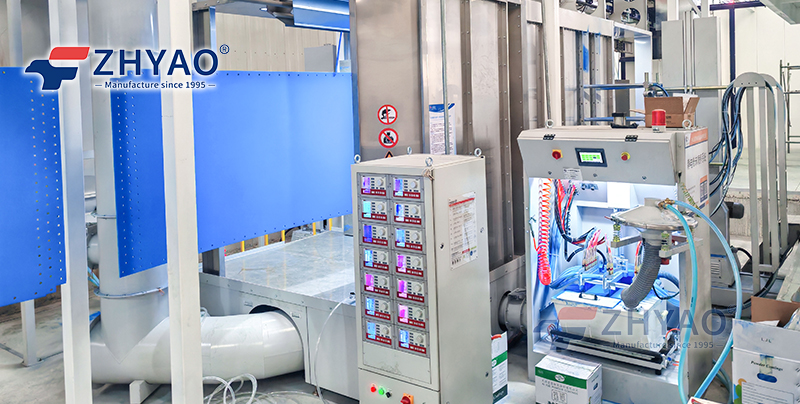
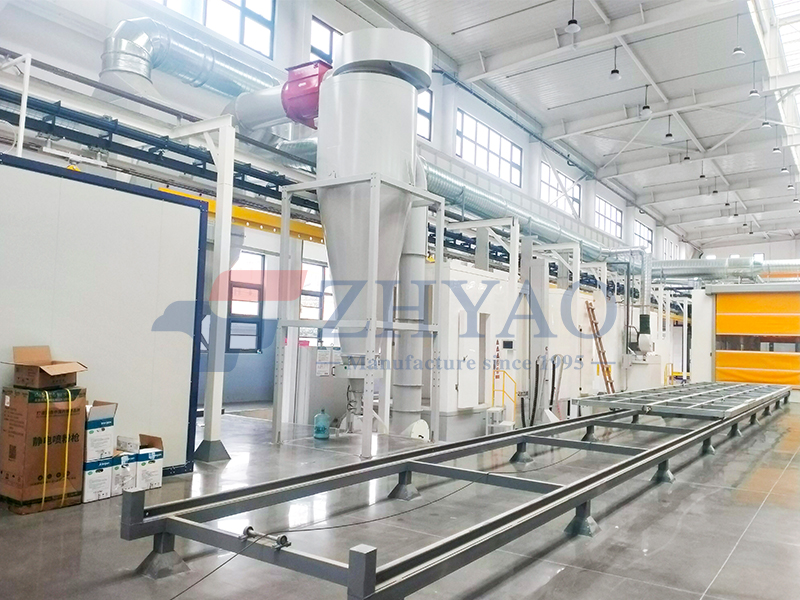
(ZHYAO's project in Shaoyang, China)
6. Evaluate Operating Costs Alongside the Initial Price
A powder coating line is a long-term production investment. Differences in operating requirements can matter as much as differences in purchase price.
Important considerations include energy consumption, labor requirements, powder utilization, routine maintenance, consumable parts, cleaning time, and expected production downtime.
For example, a curing oven's energy consumption depends on its design, insulation, loading conditions, operating schedule, and required curing process. Powder recovery performance also depends on the equipment configuration, powder characteristics, and color-change practices.
If suppliers provide operating-cost estimates, check the assumptions behind them. Figures based on different production volumes, operating hours, or energy prices should not be treated as directly comparable.
Where reliable estimates are unavailable, ask suppliers to provide the relevant technical data and explain the operating conditions. It is better to compare transparent assumptions than to rely on unsupported promises of energy savings or powder recovery rates.
7. Check Technical Specifications That Affect Long-Term Use
The initial quotation should also be reviewed for specifications that influence reliability, maintenance, and future production needs.
Depending on the project, these may include conveyor load capacity, oven temperature control, exhaust and filtration arrangements, electrical components, control systems, access for maintenance, and the availability of replacement parts.
Not every project requires the most elaborate configuration. The appropriate specifications depend on the operating environment, production requirements, maintenance capabilities, and expected service conditions.
Ask suppliers to clarify any important specification that is missing or described only in general terms. If two proposals use different technical solutions, request an explanation of the practical consequences rather than assuming that one is better because its specification sheet contains more detail.
8. Use a Consistent Comparison Before Making the Final Decision
Once the technical and commercial differences have been clarified, compare the quotations against a common set of criteria.
A practical comparison should cover:
Compliance with the required product range and coating process.
Expected production capacity and the assumptions behind it.
Completeness of the equipment configuration.
Automation level and product-changeover requirements.
Installation, commissioning, and training responsibilities.
Initial investment and estimated operating costs.
Maintenance requirements, warranty terms, and technical support.
If a quotation is substantially cheaper than the others, investigate the reason before treating it as an advantage. The difference may reflect a simpler configuration, omitted equipment, a different capacity target, or a genuinely more economical design.
Likewise, a higher quotation should be justified by identifiable technical or commercial benefits rather than a higher equipment count alone.
The best proposal is the one that meets the factory's requirements with a clear scope, realistic capacity assumptions, and acceptable long-term operating costs.
FAQ
Q1: Why do powder coating line quotations vary so much between suppliers?
Prices can differ because of equipment configuration, production capacity, automation level, pretreatment requirements, oven design, installation scope, and the specifications of individual components. Comparing these factors against the same project requirements helps explain the differences.
Q2: Should I choose the cheapest powder coating line quotation?
Not based on price alone. First confirm that the quotation includes the necessary equipment, meets the required production capacity, and clearly defines installation responsibilities and operating requirements. A lower initial price may be attractive, but the final decision should consider the complete project cost and the suitability of the proposed system.
- Previous:High-Efficiency Powder Coating Systems for Industrial Metal Products
- Next:Best Powder Coating Line Confi



 customer service