
- How Workpiece Loading Affects Powder Coating Line Capacity
- How to Design a Powder Coating Line for Different Product Sizes
- How Factory Layout Constraints Affect Powder Coating Line Design
- How to Understand a Powder Coating Line Price: What Is Behind the Quotation?
- Can One Automatic Powder Coating Line Handle Different Products? Key Factors to Consider
phone:+8618533267656
WhatsApp:+8618032661886
Email:info@powder-coatingline.com
Address:No. 55, Airport Road, Changshou Street, Xinle City, Shijiazhuang, Hebei Province
How to Design a Powder Coating Line for Different Product Sizes
The size of the workpiece is one of the first factors to consider when designing a powder coating line. However, product size does not simply determine the size of the spray booth or curing oven. It can affect the conveyor, hanger design, production spacing, spraying method, pretreatment equipment, oven configuration, workshop layout, and even the level of automation.
A line designed for small metal parts may not be suitable for large frames or long profiles, even if the required production volume is similar.
The key is to design the coating line around the actual product range rather than selecting equipment independently.
Start With the Actual Product Range
Before designing the line, the supplier needs more than one product dimension.
The basic information should include:
- Maximum length, width, and height
- Minimum and typical product dimensions
- Maximum product weight
- Product shape and geometry
- Material
- How the product will be hung
- Required production output
- Number of products per hanger
- Expected product mix
The largest product is important, but it should not automatically determine every part of the line.
For example, a factory may produce both small brackets and large metal frames. Designing the entire system around the largest frame could create unnecessary space and equipment requirements for smaller products. A better solution may be to define several product groups and determine how each group will move through the line.
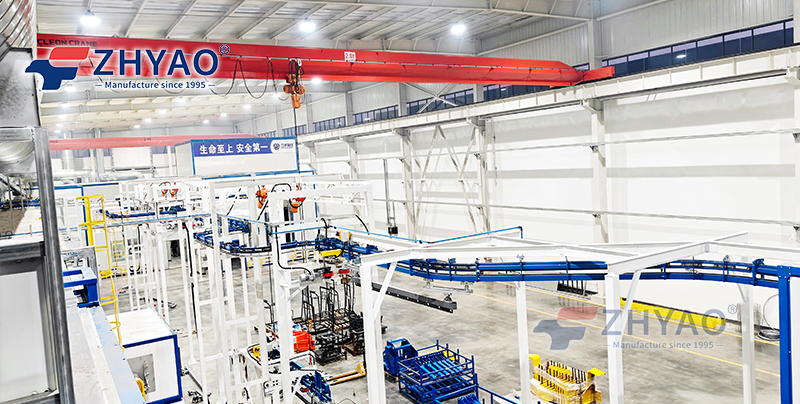
(Accumulating Conveyor Installation Site in Australia)
Think About the Product Envelope, Not Just Its Dimensions
The physical dimensions of a product are only the starting point.
Once a product is mounted on a hanger, its effective size inside the coating line changes. The hanging orientation, fixture structure, and distance from adjacent products all create additional space requirements.
A long metal profile, for example, may be transported vertically or horizontally. The two arrangements can require very different conveyor heights, booth openings, oven dimensions, and workshop layouts.
This means product drawings alone may not be enough. The planned hanging position should also be considered during line design.
Small Products Need a Different Production Strategy
Small workpieces can often be loaded in groups on one hanger, depending on their shape, weight, coating requirements, and quality requirements.
This can increase the number of parts processed during each conveyor cycle. However, grouping products also changes the effective load and spraying arrangement.
For small parts, the design may therefore focus on:
- Efficient hanger utilization
- Stable product spacing
- Automatic or manual spraying according to production volume
- Easy loading and unloading
- Powder recovery efficiency
- Flexible production of different small parts
The objective is not simply to make the conveyor move faster. The hanger arrangement and spraying capacity must work together with the required output.
Medium-Sized Products Usually Require Balanced Line Design
Medium-sized products are often easier to integrate into a conventional conveyorized powder coating line.
The main design considerations become the relationship between product dimensions, hanger pitch, conveyor speed, spray coverage, and curing time.
If products are regularly spaced on the conveyor, the required production rate can be evaluated from the conveying speed and hanger pitch. Increasing production capacity may therefore require changes to conveyor speed, spacing, spraying capacity, or the number of products carried per hanger rather than simply enlarging the equipment.
This is particularly important when a factory plans to coat several products with similar dimensions but different weights or shapes.
Large and Long Products Require More Attention to Clearance
Large products create a different set of design challenges.
A large workpiece needs enough clearance to pass through pretreatment equipment, the powder booth, curing oven, and cooling area without interfering with equipment or adjacent products.
Its size can also affect:
- Conveyor route
- Hanger strength and configuration
- Workshop height
- Booth opening
- Oven opening
- Spray gun position
- Operator access
- Maintenance space
Long profiles and large frames can be especially sensitive to orientation. A change from horizontal to vertical hanging can completely change the required line dimensions.
For heavy products, weight must also be considered together with size. A conveyor that has sufficient physical clearance may still require a different load capacity or support arrangement.
Hanger Design Should Be Decided Early
The hanger is the connection between the product and the conveyor, but its influence extends throughout the coating line.
A suitable hanger should support the product securely while maintaining appropriate access for pretreatment, powder spraying, and curing.
For different product sizes, the hanger may need to change in:
- Load capacity
- Hook spacing
- Product orientation
- Number of products per hanger
- Contact points
- Fixture shape
The hanger also influences the distance between products. This affects how many products can be transported through the line within a given period.
Therefore, hanger design should not be treated as a final accessory after the main equipment has been selected.
Conveyor Design Changes With Product Size and Weight
The conveyor is one of the most important parts of a size-adaptive powder coating line.
For smaller and lighter products, a conventional overhead conveyor arrangement may provide sufficient capacity. For heavier or larger workpieces, the conveyor structure, trolley or hanger configuration, support arrangement, and load capacity may need to be reconsidered.
The conveyor route must also provide sufficient clearance around the largest product.
For factories producing several product sizes, the design may need to accommodate different hanging positions or controlled spacing. In some applications, accumulation and release sections can also help manage different processing rates between production stages.
Spray Equipment Should Match the Product Mix
Product size also affects the spraying method.
Small, regular products with stable production volumes may be suitable for automatic powder spraying.
Large products with complicated geometries may require a combination of automatic spraying and manual touch-up, particularly where certain surfaces, corners, recesses, or product variations are difficult to cover consistently with fixed automatic guns.
The number and position of automatic guns should therefore be determined from the actual product geometry rather than from production volume alone.
A factory producing products with very different dimensions may need a more flexible spraying arrangement than a factory producing one standardized product.

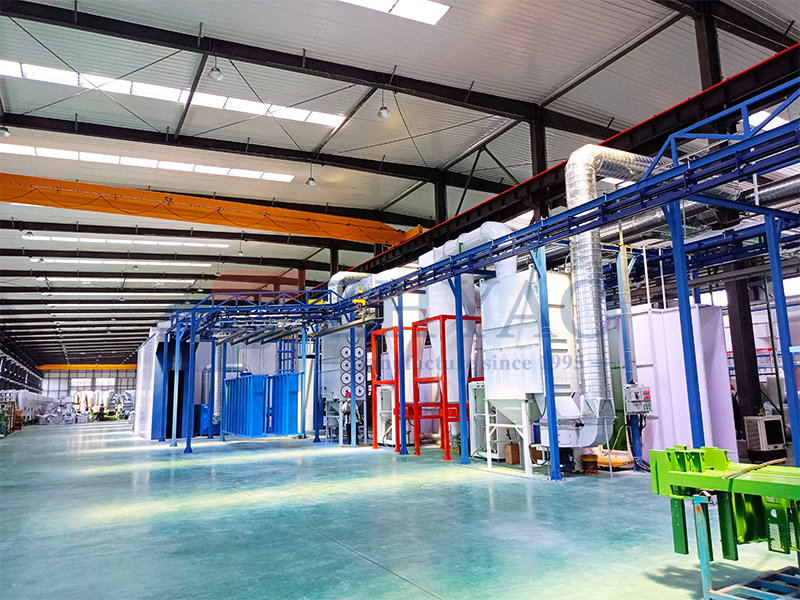
(Powder coating line installation site in Australia)
Pretreatment Must Also Accommodate the Largest Product
Product size affects pretreatment equipment as well.
The pretreatment method may be spray, immersion, shot blasting, or another process depending on the product material, surface condition, geometry, and production requirements.
For a conveyorized line, the largest product must be able to pass through the required pretreatment stages while maintaining appropriate process conditions.
This does not mean every pretreatment section should simply be made larger. The design should consider the actual process requirements, product orientation, loading method, and production speed.
For factories with significant differences between product sizes, the pretreatment solution may need to be evaluated based on the product groups rather than only the maximum external dimensions.
The Curing Oven Must Match the Product Envelope
The curing oven is another area where product size has a direct effect on design.
The oven must provide sufficient internal space for the largest workpiece and its hanger arrangement. At the same time, the curing process must provide the required temperature and time specified for the powder being used and the actual workpiece.
The oven should therefore be evaluated together with:
- Product dimensions
- Product orientation
- Conveyor speed
- Hanger pitch
- Product loading
- Required curing schedule
- Heat distribution requirements
A larger workpiece does not automatically mean that the curing temperature should be increased. Powder manufacturer's curing requirements and actual workpiece temperature should remain the basis for determining the curing process.
When One Line Handles Multiple Product Sizes
Many factories do not produce one product size all year.
A more practical design approach is to divide products into size groups, such as:
Small parts → Medium parts → Large parts
Then determine whether the same conveyor, hanger system, spray equipment, and oven can accommodate all three groups.
For example, small products may be grouped on one hanger, while large products may require one hanger per piece. The production capacity of these two modes can therefore be very different even when the conveyor itself does not change.
The goal is to find a workable operating range rather than designing the entire system around one extreme product.
Do Not Design the Line Around Size Alone
Product dimensions are important, but they are only one part of the design.
A powder coating line should be developed from the relationship between:
Product size → hanging method → conveyor load and spacing → spraying method → pretreatment → curing → production output → workshop layout
Changing one factor can affect several downstream sections.
For example, increasing the maximum product height may require a different hanging orientation. That change can affect conveyor height, booth opening, oven dimensions, workshop clearance, and material flow.
This is why a powder coating line should be designed as one integrated production system rather than by selecting each machine separately.
Information to Provide Before Requesting a Line Design
A factory planning a new powder coating line should prepare as much product information as possible.
Useful information includes:
- Product drawings or photos
- Maximum and minimum product dimensions
- Product weight
- Material
- Product quantity
- Required daily or hourly output
- Working hours
- Product variety
- Preferred hanging method, if known
- Powder type and curing requirements
- Existing pretreatment or coating equipment
- Workshop length, width, and height
- Column and door positions
- Available utilities
With this information, the equipment supplier can evaluate the product range together with the production target and workshop conditions before determining the conveyor, spraying system, pretreatment, curing oven, and overall layout.
The Right Design Is the One That Matches the Product Range
There is no single powder coating line configuration that is suitable for every product size.
Small parts may benefit from efficient hanger utilization and higher loading density. Medium-sized products usually require a balance between conveyor speed, spacing, spraying, and curing. Large or heavy products require more attention to clearance, conveyor load, hanging orientation, and workshop space.
For factories producing multiple product sizes, the most important step is to define the actual product range before selecting equipment.
A well-designed powder coating line should not simply accommodate the largest product. It should provide a practical production method for the products the factory actually plans to manufacture.
FAQ: Can one powder coating line handle products with different sizes?
Yes. One powder coating line can often handle multiple product sizes if the conveyor load, hanger design, product clearance, spraying method, pretreatment process, and curing requirements are compatible. The product range should be defined during the design stage so that the line is not optimized for only one product.
FAQ: What product information is needed to design a powder coating line?
At minimum, provide the maximum and minimum product dimensions, weight, shape, material, production quantity, working hours, product variety, and planned hanging method. Product drawings or photos are also useful. If the factory already has a workshop, its length, width, height, columns, doors, and existing equipment should also be provided.
- Previous:How to Understand a Powder Coating Line Price: What Is Behind the Quotation?
- Next:How Workpiece Loading Affects



 customer service