
- How Automatic Powder Spray Guns Work: Inside the Powder Coating Process
- How to Choose the Right Powder Coating Booth | ZHYAO
- Common Mistakes When Buying Powder Coating Equipment
- Shandong Lijian CNC Machine Tool Powder Coating Line Installation Completed
- Powder Coating Line ROI Analysis: What Should Manufacturers Calculate Before Investing?
phone:+8618533267656
WhatsApp:+8618032661886
Email:info@powder-coatingline.com
Address:No. 55, Airport Road, Changshou Street, Xinle City, Shijiazhuang, Hebei Province
Common Mistakes When Buying Powder Coating Equipment
What manufacturers should check before choosing powder coating equipment for a new or upgraded production line
Choosing Equipment by Price Instead of Production Requirements
One of the most common mistakes when purchasing powder coating equipment is comparing prices before defining the production requirements.
A low equipment price may look attractive, but it does not necessarily mean the system will match the products, production volume, or coating process.
Before requesting a quotation, it is more useful to define the workpiece material, dimensions, weight, daily output, coating type, color requirements, and expected working hours. These details give equipment suppliers a practical basis for developing a suitable configuration.
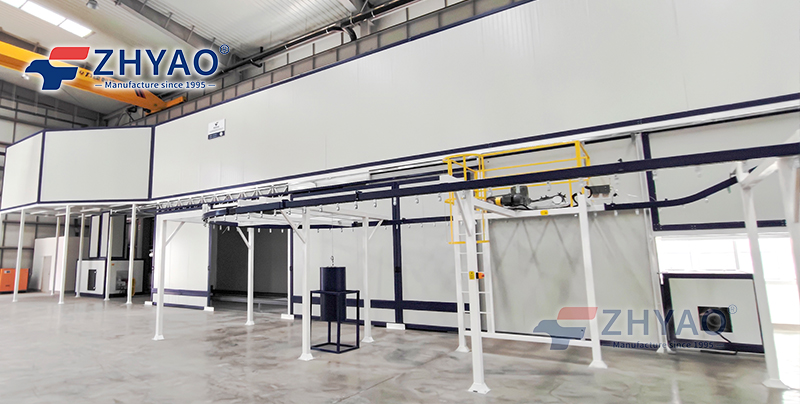
Using the Same Configuration for Different Products
Powder coating equipment cannot be designed effectively from the product name alone.
A line for small metal hardware is very different from a line for large cabinets, steel structures, aluminum profiles, or long pipes. Workpiece dimensions affect the spray booth, conveyor, oven, hanger design, and factory layout.
Even when two factories have similar production volumes, their equipment requirements can be different because of product size and production methods.
Underestimating Pretreatment Requirements
Some buyers focus heavily on powder spraying equipment while giving less attention to surface preparation.
However, oil, rust, scale, welding residue, and other contaminants can affect coating adhesion and corrosion performance. The appropriate pretreatment method depends on the substrate and surface condition.
For industrial powder coating lines, common options include spray pretreatment, immersion tank pretreatment, and shot blasting.
Selecting between them should be based on the actual workpiece and coating requirements rather than simply choosing the equipment that appears easier to install.
Selecting the Oven Only by Its External Size
The curing oven is another area where purchasing decisions can go wrong.
A larger oven does not automatically provide better curing, and a smaller oven may not provide enough residence time for the required production speed.
The oven needs to be evaluated together with conveyor speed, workpiece weight, loading density, powder curing requirements, and temperature distribution.
The relevant question is not simply how large the oven is, but whether the workpiece can reach and maintain the required curing condition.
Ignoring the Hanging Method
The way products are mounted on the conveyor directly affects coating efficiency.
If the hanger blocks important surfaces, powder cannot reach those areas properly. If large workpieces are hung too closely together, they may interfere with each other during spraying or transportation.
For smaller parts, several pieces may be mounted on one hanger to increase production density. For larger or more complex products, individual hanging positions may be more appropriate.
Hanger design should therefore be considered during equipment selection rather than treated as a minor accessory.
Expecting Automatic Spraying to Solve Every Coating Problem
Automatic spray guns can improve production consistency and reduce manual spraying work, but automation does not automatically solve every coating problem.
Workpiece geometry, grounding, gun positioning, spray distance, powder characteristics, and conveyor movement all influence the final coating.
Products with deep corners or complicated structures may still require specific gun arrangements or manual touch-up areas. The equipment should be designed around the actual surfaces that need to be coated.
Not Considering Color Change Frequency
A powder coating line that runs one color for long periods has different requirements from a factory that changes colors several times a day.
Frequent color changes increase the importance of booth cleaning, powder recovery, powder feeding, and production scheduling. If this requirement is not discussed before purchasing the equipment, the operator may later spend more time cleaning the system than expected.
Color-change frequency should be included in the original equipment planning.
Buying More Automation Than the Factory Needs
Automation can improve production efficiency, but more automation is not always the right investment.
A factory with low production volume and many different products may not benefit from the same automation configuration as a high-volume manufacturer producing standardized parts.
Manual, semi-automatic, and fully automatic equipment can each have a place depending on production volume, labor conditions, product variety, and budget.
The better approach is to determine which operations actually need automation instead of adding automated equipment simply because it is available.
Forgetting About Factory Utilities
Powder coating equipment needs more than floor space.
The factory may need electrical power, compressed air, ventilation, gas supply for certain ovens, exhaust systems, water treatment, and suitable working areas for powder and finished products.
If these requirements are not considered during the purchasing stage, installation may require unexpected modifications to the factory.
A proper equipment proposal should therefore consider utilities as part of the complete project rather than treating them as a separate issue after the equipment has been ordered.
Calculating Output From Theoretical Capacity
Equipment suppliers may provide a theoretical production capacity based on conveyor speed, hanger pitch, or the number of workpieces per hanger.
Actual production can be lower because of loading, unloading, product changes, cleaning, maintenance, curing requirements, and other operating conditions.
Buyers should distinguish between theoretical line capacity and realistic daily production. A production target based on actual working conditions provides a more useful basis for equipment selection.
Leaving Too Little Room for Future Products
A powder coating line is often expected to operate for many years. Purchasing equipment based only on today's smallest or simplest product can create limitations later.
A factory may add larger workpieces, increase output, introduce new colors, or change its production mix.
It does not mean that every possible future product needs to be accommodated. However, identifying likely changes before equipment design can provide useful flexibility without unnecessarily increasing the initial investment.
Comparing Quotations Without Comparing Specifications
Two powder coating equipment quotations can have very different prices while appearing similar on paper.
The difference may come from conveyor type, oven heating method, pretreatment stages, spray gun quantity, powder recovery system, control system, filtration, installation scope, or other components.
For this reason, buyers should compare the technical configuration and project scope rather than comparing only the final quotation amount.
A simple specification table can make the differences much easier to identify.
Not Asking About Installation and Commissioning
Industrial coating equipment is not simply delivered and connected like a standard machine.
The conveyor, pretreatment equipment, spray booth, curing oven, powder system, electrical controls, and other sections need to work together. Installation and commissioning can affect the final operating condition of the line.
Before signing a purchase agreement, it is useful to confirm what the supplier is responsible for during installation, commissioning, operator training, and after-sales support.
Choosing Equipment Without Looking at the Complete Process
Another common mistake is purchasing individual machines without considering how they will work as a complete production line.
A powder coating system may include loading, pretreatment, drying, powder spraying, powder recovery, curing, cooling, and unloading. The conveyor connects these stages and determines the movement of the workpieces through the process.
If one section is oversized while another becomes a bottleneck, the overall production capacity will still be limited.
A complete process calculation is therefore more useful than selecting each machine independently.
A Better Way to Approach Powder Coating Equipment Purchasing
A practical purchasing process usually starts with the products and production plan.
Prepare the workpiece dimensions, material, weight, daily output, working hours, coating requirements, color changes, factory dimensions, and desired automation level. Then use this information to compare different equipment configurations.
The goal is not simply to purchase more equipment or find the lowest quotation. It is to build a powder coating system that fits the actual production process and remains practical to operate and maintain.
For manufacturers considering a new powder coating line or upgrading an existing system, careful planning before the purchase can prevent many problems that are expensive or difficult to correct after installation.
Frequently Asked Questions
- What information should I provide when requesting a powder coating equipment quotation?
Useful information includes workpiece material, length, width, height, weight, daily production target, working hours, coating type, number of colors, factory dimensions, and the required level of automation.
Photos or drawings of the workpieces can also help with equipment planning.
- Is the cheapest powder coating equipment quotation the best choice?
Not necessarily. The price should be evaluated together with the equipment configuration, production capacity, pretreatment process, oven design, powder recovery, installation, commissioning, and after-sales support.
A lower initial price may not provide the most suitable solution for the actual production requirements.
- Previous:Powder Coating Line ROI Analysis: What Should Manufacturers Calculate Before Investing?
- Next:How Automatic Powder Spray Gun
-
2026-09-04How to Plan a New Powder Coating Workshop



 customer service