
- How to Plan a New Powder Coating Workshop
- How to Choose the Right Pretreatment System for Your Factory
- How to Design an Industrial Spray Painting Line for Your Factory
- Spray Painting Line Cost: What Affects the Total Investment?
- Spray Painting Equipment Manufacturers in China: How to Choose the Right Supplier
phone:+8618533267656
WhatsApp:+8618032661886
Email:info@powder-coatingline.com
Address:No. 55, Airport Road, Changshou Street, Xinle City, Shijiazhuang, Hebei Province
How to Choose the Right Pretreatment System for Your Factory
Before powder coating, the metal surface needs to be properly prepared. Oil, rust, scale, dust and other contaminants can affect coating adhesion and final appearance if they are not removed effectively.
There is no single pretreatment system suitable for every type of metal product. At ZHYAO, pretreatment solutions are mainly configured around three process types: immersion pretreatment, shot blasting pretreatment and spray pretreatment.
The right choice depends on the material, surface condition, workpiece structure and production method.
1. Immersion Pretreatment for Complex Workpieces
Immersion pretreatment uses a series of treatment tanks to process the workpieces.
The parts are placed into different tanks according to the required process. Because the workpiece is immersed in the treatment solution, the liquid can contact surfaces that may be difficult for conventional spray nozzles to reach.
This makes immersion pretreatment particularly useful for products with complicated structures, deep recesses, internal areas or irregular shapes.
It can also be a practical option for factories using batch production, where different groups of workpieces need to be processed according to a flexible production schedule.
The actual tank sequence, tank dimensions and treatment parameters should be determined according to the material and required surface treatment process.
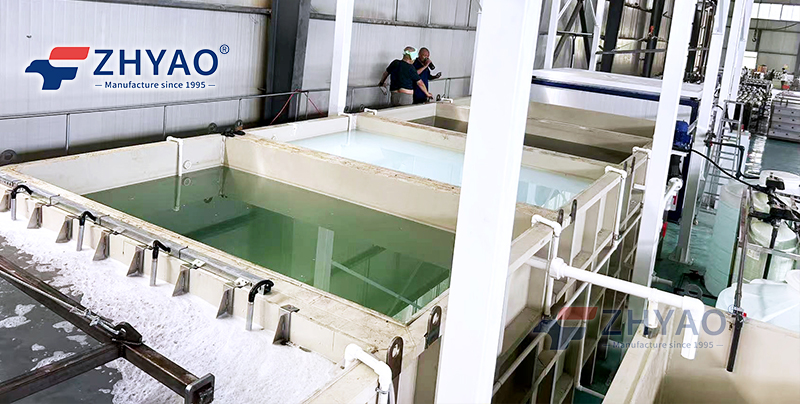
(Dip-Tank Pre-treatment – China Jilin Lixin Group)
2. Shot Blasting for Steel With Rust and Scale
Shot blasting takes a different approach from chemical pretreatment.
Steel shot or other abrasive media are propelled at the metal surface at high speed. This mechanical action removes rust, mill scale, old surface contamination and other unwanted material from the workpiece.
Shot blasting is commonly considered for steel structures, fabricated steel components, heavy-duty parts and products with significant rust or scale.
Another benefit is that blasting can create a suitable surface profile for subsequent coating. This makes it particularly relevant when surface preparation requires more than simple degreasing and cleaning.
For factories processing structural steel or heavily contaminated metal parts, shot blasting can be an important part of the overall coating process.
3. Spray Pretreatment for Continuous Coating Lines
Spray pretreatment is commonly integrated into continuous powder coating lines.
Workpieces are transported through different treatment sections while chemical solutions are sprayed onto their surfaces. Depending on the required process, the line can include cleaning, rinsing, surface conditioning and other treatment stages.
The continuous configuration works well when products are loaded onto a conveyor and processed at a relatively stable production rhythm.
Spray pretreatment is often considered for metal products such as hardware, appliances, profiles, automotive components, sheet-metal parts and other products suitable for conveyorized production.
The number of treatment stages should be determined by the actual material and coating specification rather than simply adding more stages.
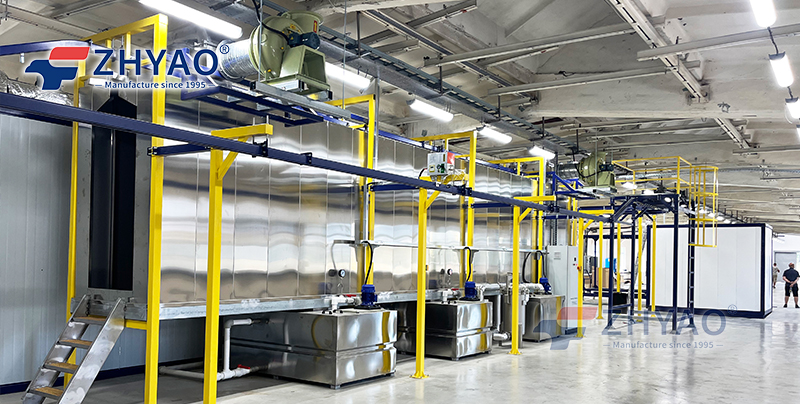
The Surface Condition Determines the Starting Point
Before choosing between the three systems, look at the condition of the incoming material.
A newly fabricated steel part with oil and dust has different requirements from steel that has already developed rust and mill scale.
If the main issue is surface contamination and the workpieces can be effectively treated by chemical cleaning, spray or immersion pretreatment may be suitable.
If the surface contains substantial rust or scale, shot blasting may provide the mechanical preparation required before coating.
This distinction is important because pretreatment is not simply about washing the workpiece. The process needs to produce a surface condition that is suitable for the next coating stage.
Workpiece Shape Also Changes the Choice
Workpiece geometry can strongly influence pretreatment effectiveness.
Simple flat or open surfaces are generally easier to treat with spray systems. Complicated structures may have corners, narrow gaps, cavities or internal surfaces where direct spray coverage is difficult.
Immersion can provide better contact with many difficult surfaces because the workpiece is surrounded by the treatment solution.
For large steel structures, however, mechanical preparation with shot blasting may be more practical when rust and scale are the main concerns.
The workpiece should therefore be evaluated as a three-dimensional object rather than simply by its length, width and height.
Production Method Matters as Much as Product Type
Two factories producing similar parts may still require different pretreatment systems.
One factory may produce several batches of different products each day, while another may operate a continuous automated powder coating line.
Immersion pretreatment can provide useful flexibility for batch processing. Spray pretreatment is more naturally connected with continuous conveyor production. Shot blasting is often selected according to the surface preparation requirements of steel products.
Production volume, working hours, conveyor speed and loading method should all be considered when determining the final configuration.
Pretreatment Must Connect With the Drying Process
The pretreatment section is only one part of the coating line.
After washing and rinsing, moisture needs to be removed before powder spraying. This means the pretreatment process and drying oven need to be considered together.
Workpieces with holes, grooves or recessed areas may retain water after treatment. Their geometry and production speed can therefore influence the drying requirements.
A properly designed line should maintain a logical transition:
Loading → Pretreatment → Drying → Powder Spraying → Powder Curing → Cooling → Unloading
The pretreatment system should support this complete production flow rather than operate as an independent piece of equipment.
Factory Space Should Be Considered Before Equipment Selection
Pretreatment equipment can occupy a significant part of a coating line.
Immersion systems require space for treatment tanks, pumps, piping and maintenance access. Spray systems require treatment chambers, pumps, piping, exhaust and water-management equipment. Shot blasting requires a dedicated blasting area and suitable abrasive recovery and dust-control arrangements.
For a new factory, the pretreatment section should be included when planning the overall production layout.
For an existing factory, available building length, height, column positions, material flow and equipment access can directly affect the final design.
Maintenance Is Part of the Pretreatment Solution
Pretreatment equipment operates continuously around water, chemicals, dust and metal contamination.
Spray nozzles and filters require inspection. Immersion tanks need regular cleaning and solution management. Shot blasting equipment requires maintenance of abrasive circulation and wear components.
A practical system should allow operators to access the components that require routine inspection and maintenance.
This is particularly important for factories planning long-term automated production. A pretreatment line should not only work when newly installed; it should also remain manageable during everyday operation.
How to Choose Between the Three Pretreatment Methods
A simple way to make the initial selection is to look at the main production problem.
Immersion pretreatment: suitable when workpieces have complicated structures or when batch processing and liquid contact around the parts are important.
Shot blasting pretreatment: suitable when steel workpieces have rust, mill scale, old coating or other heavy surface contamination requiring mechanical preparation.
Spray pretreatment: suitable when workpieces can move continuously through treatment stages and the factory requires an integrated conveyorized coating process.
In some projects, the decision is not simply about choosing one method. The overall coating process may require different surface preparation stages according to the material and condition of the products.
What Information Should Be Prepared Before Asking for a Solution?
A pretreatment system cannot be properly designed from the product name alone.
Before discussing equipment configuration, it is useful to prepare the following information:
- Workpiece material
- Maximum and minimum workpiece dimensions
- Maximum workpiece weight
- Surface condition
- Oil, rust or scale condition
- Daily production quantity
- Working hours
- Batch or continuous production
- Required coating process
- Available factory space
- Expected level of automation
With this information, the pretreatment process can be matched to the actual production conditions instead of relying on a standard configuration.
Conclusion
Choosing a pretreatment system is essentially a process-matching decision.
For different production requirements, ZHYAO can configure immersion pretreatment, shot blasting pretreatment or spray pretreatment. Immersion focuses on effective liquid treatment for suitable complex or batch-processed workpieces; shot blasting provides mechanical surface preparation for steel with rust and scale; spray pretreatment fits continuous conveyorized coating production.
The best configuration depends on the workpiece, surface condition and complete coating process—not simply on the equipment name or number of treatment stages.
FAQ
1. What are the three main pretreatment systems offered by ZHYAO?
ZHYAO mainly provides immersion pretreatment, shot blasting pretreatment and spray pretreatment. The appropriate system is selected according to the workpiece material, surface condition, shape and production requirements.
2. Is shot blasting or chemical pretreatment better for steel parts?
It depends on the surface condition. Shot blasting is suitable when steel has significant rust, mill scale or other heavy contamination. Chemical pretreatment may be more appropriate when the main requirement is cleaning and surface conditioning. The actual process should be determined from the workpiece condition and coating requirements.
- Previous:How to Design an Industrial Spray Painting Line for Your Factory
- Next:How to Plan a New Powder Coati
-
2026-09-04How to Plan a New Powder Coating Workshop
-
2026-08-31How to Choose a Powder Coating Line



 customer service