
- How to Choose the Right Pretreatment System for Your Factory
- How to Design an Industrial Spray Painting Line for Your Factory
- Spray Painting Line Cost: What Affects the Total Investment?
- Spray Painting Equipment Manufacturers in China: How to Choose the Right Supplier
- How to Choose a Powder Coating Line
phone:+8618533267656
WhatsApp:+8618032661886
Email:info@powder-coatingline.com
Address:No. 55, Airport Road, Changshou Street, Xinle City, Shijiazhuang, Hebei Province
How to Design an Industrial Spray Painting Line for Your Factory
Begin With the Production Process
An industrial spray painting line should be designed around the actual manufacturing process. Before selecting equipment, define how the workpieces enter the line, how they are prepared, painted, dried or cured, inspected, and finally removed.
This process map provides the basis for deciding where each piece of equipment belongs and how the different stages should connect.
Define the Product Range
Start by identifying the workpieces the factory expects to process. Material, maximum dimensions, weight, geometry, surface condition, and required coating thickness all influence the design.
If one line will handle several products, use the largest and heaviest regular workpieces as important design references while also checking whether smaller parts can be handled efficiently.
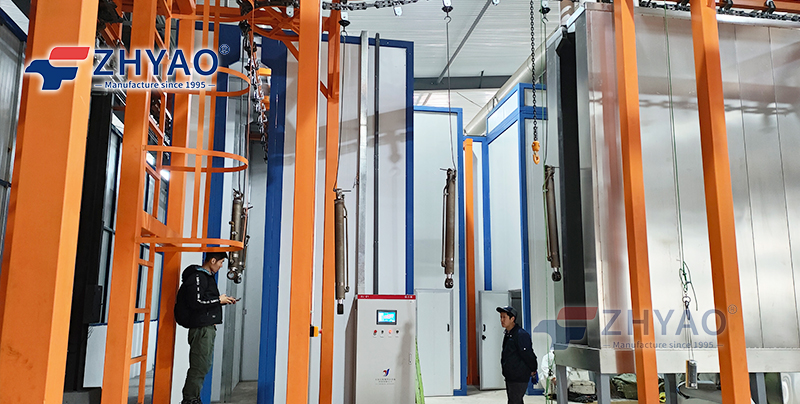
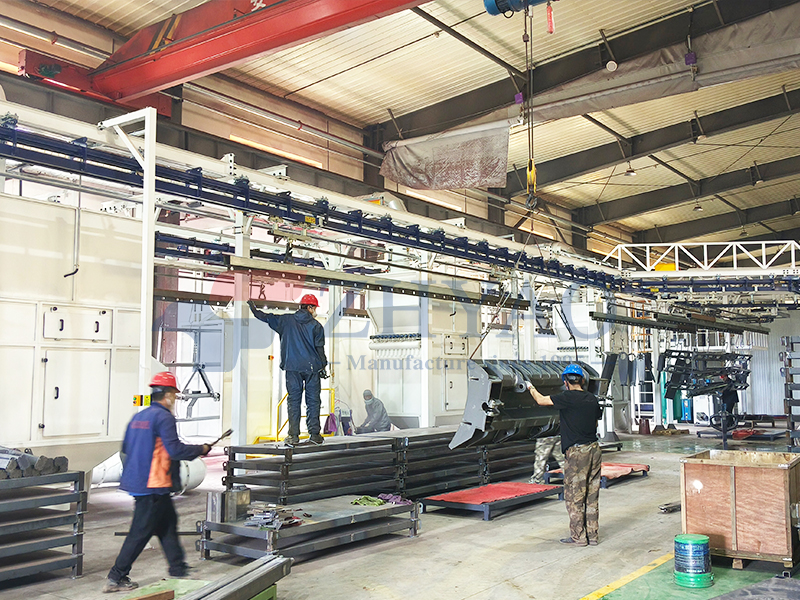
(ZHYAO Yantai Shanhe Hydraulic Machine Painting Line Project)
Plan the Material Flow
A good layout should allow workpieces to move through production without unnecessary backtracking.
Loading, pretreatment, drying, spray painting, flash-off, curing, cooling, inspection, and unloading should have a logical sequence. Adequate space should also be left for temporary storage and operator access between major stages.
Select Surface Preparation
Paint adhesion depends heavily on the condition of the substrate. The preparation method should be selected according to the material and contamination level.
For suitable steel components, shot blasting can remove rust, mill scale, and old coatings. Spray pretreatment can provide continuous chemical cleaning, while immersion pretreatment may be useful for parts with complex structures that require treatment around different surfaces.
Design the Spray Painting Area
The spray booth should provide sufficient working space for the largest products and the selected spray equipment.
For manual painting, operators need safe access and appropriate working clearance. Automatic spray guns, reciprocators, or robotic systems require additional space for movement and maintenance.
Ventilation and filtration should be designed together with the booth to control paint mist and maintain suitable working conditions.
Choose the Right Material Handling Method
Large industrial workpieces often require a reliable material handling system. An overhead conveyor may be suitable for products that can be suspended, while other applications may require floor conveyors, carts, or customized handling arrangements.
Load capacity, product orientation, transfer points, and maintenance access should all be considered before finalizing the handling system.
Allow Enough Drying or Curing Time
The required process time depends on the coating material and product.
Water-based or solvent-based coatings may require flash-off and drying stages, while certain industrial coating systems require thermal curing. The length and configuration of these areas should correspond to the coating specification and planned production speed.
Plan Ventilation Carefully
Ventilation is not simply an accessory added to the spray booth. Exhaust capacity, air movement, filtration, duct routing, and make-up air can influence the painting environment and operating conditions.
The system should be designed according to the coating materials and applicable local safety and environmental requirements.
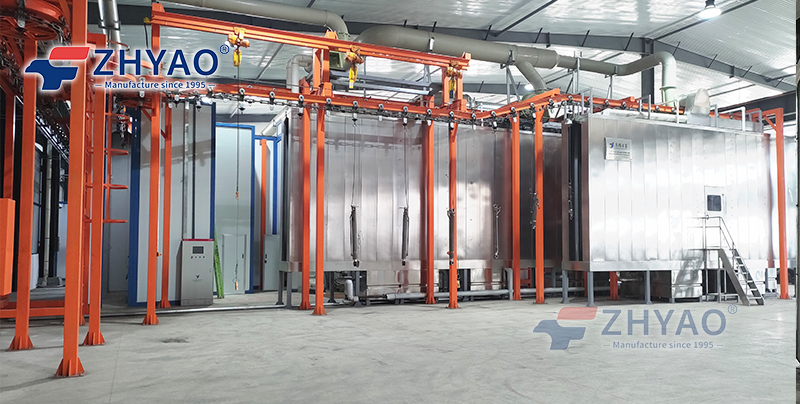
Integrate the Control System
An industrial spray painting line may involve conveyors, pumps, spray equipment, fans, heaters, sensors, and safety devices.
A centralized control system can coordinate these components and provide monitoring of key operating conditions. Safety interlocks and emergency-stop functions should also be incorporated into the overall design.
Design Around the Factory
The available building height and floor area are only part of the planning process. Columns, doors, loading areas, utilities, drainage, ventilation routes, and existing production equipment can all affect the final layout.
For an existing factory, measuring the workshop before equipment design can prevent major changes later.
Leave Room for Maintenance
Production equipment needs service access throughout its operating life. Fans, pumps, filters, burners, spray equipment, conveyors, and control cabinets should remain accessible after installation.
Maintenance space should be included in the layout instead of using every available area for production equipment.
Conclusion
Designing an industrial spray painting line requires coordination between product characteristics, material flow, surface preparation, spray application, drying or curing, ventilation, material handling, controls, and factory conditions.
The most practical design is not necessarily the one with the largest equipment or highest automation level. It is the system in which each stage supports the next and the entire process fits the factory's actual production requirements.
FAQ
What information is needed to design an industrial spray painting line?
Workpiece material, dimensions, weight, coating type, surface condition, production output, process requirements, and available factory dimensions are the main starting points.
Can an industrial spray painting line be customized for an existing factory?
Yes. The conveyor route, booth dimensions, equipment arrangement, and utilities can be planned around existing building conditions, provided sufficient space and required services are available.
- Previous:Spray Painting Line Cost: What Affects the Total Investment?
- Next:How to Choose the Right Pretre
-
2026-08-31How to Choose a Powder Coating Line



 customer service