
- How Factory Space and Layout Affect Powder Coating Line Design
- How Workpiece Loading Affects Powder Coating Line Capacity
- How to Design a Powder Coating Line for Different Product Sizes
- How Factory Layout Constraints Affect Powder Coating Line Design
- How to Understand a Powder Coating Line Price: What Is Behind the Quotation?
phone:+8618533267656
WhatsApp:+8618032661886
Email:info@powder-coatingline.com
Address:No. 55, Airport Road, Changshou Street, Xinle City, Shijiazhuang, Hebei Province
How Workpiece Loading Affects Powder Coating Line Capacity
When evaluating a powder coating line, buyers often focus on conveyor speed, spray guns, booth size, or curing oven capacity. However, the loading station can also become a limiting factor.
If workpieces cannot be loaded at the required pace, or if their size, spacing, and hanging position are inconsistent, the theoretical capacity of the downstream equipment may never be reached.
For this reason, workpiece loading should be considered as part of the production capacity calculation rather than treated as a separate manual operation.
Production Capacity Starts at the Loading Station
A powder coating line needs a continuous and predictable flow of workpieces.
The basic relationship can be considered as:
Target output → loading frequency → hanger arrangement → workpiece spacing → conveyor speed
For example, if a factory needs to coat 300 parts per hour, the loading operation needs to supply the conveyor with the required number of parts at a stable interval.
If the loading cycle is too slow, empty hanger positions will appear on the conveyor. The spray booth and curing oven may still be running, but the line is processing below its potential capacity.
This is why the capacity of a powder coating line should not be calculated from conveyor speed alone.
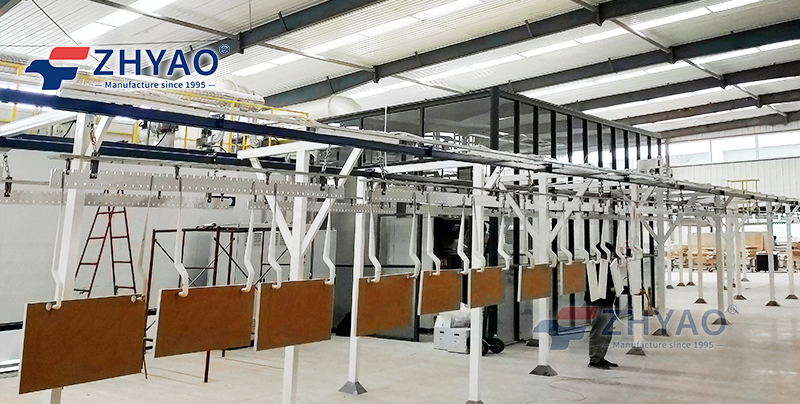
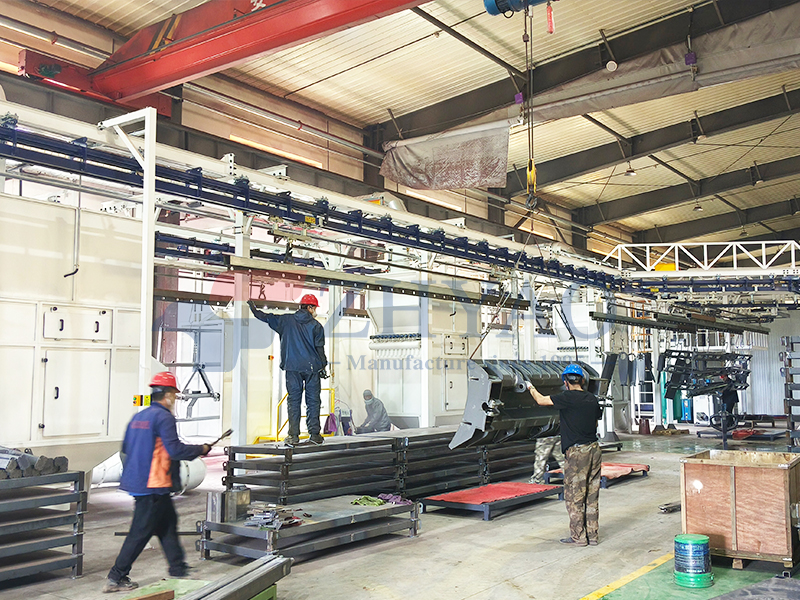
(ZHYAO Xingtang Panel Coating System)
Workpiece Size Changes the Real Production Capacity
The same conveyor can have very different output depending on the workpiece.
Small components may allow several pieces to be loaded onto one hanger, while large components may require one hanger for each part. Large or irregular parts may also need greater spacing to maintain adequate spray access.
Consider two factories with the same conveyor speed. One coats small metal brackets, while the other coats large welded frames. Their actual hourly output can be completely different.
Therefore, when a supplier calculates the capacity of a proposed line, buyers should provide the actual workpiece dimensions rather than relying on a single average product.
If several product sizes will share the line, the calculation should consider the products that represent normal production conditions, including larger parts that may occupy more conveyor space.
Hanger Arrangement Directly Affects Output
The hanger determines how many workpieces can be carried through a given length of conveyor.
A suitable hanger should provide stable support while allowing the part to maintain an appropriate position during pretreatment, powder spraying, and curing.
For some products, multiple pieces can be placed on one hanger. For others, the geometry or weight may require a dedicated hanger.
This means hanger design can affect the number of parts processed per hour without changing the conveyor itself.
For factories with several product families, different hanger designs may be required. The purchasing team should therefore ask how the proposed hanger arrangement affects the calculated production capacity.
Workpiece Spacing Creates a Balance Between Output and Coating Access
Reducing the distance between workpieces may appear to be an easy way to increase production.
However, parts that are too close together can interfere with powder application. One workpiece may block the spray path to another, particularly when products have frames, deep recesses, brackets, or overlapping sections.
There is also a risk of parts touching if they move or swing during transportation.
On the other hand, excessive spacing means fewer workpieces can pass through the spray and curing sections during the same period.
The appropriate spacing therefore needs to balance two requirements:
Use the conveyor efficiently while providing enough space for reliable coating.
The correct distance depends on the workpiece dimensions, hanger design, spray arrangement, conveyor movement, and production requirements.
Loading Consistency Matters for Automatic Powder Coating
Loading affects not only the number of parts entering the line, but also how they are presented to automatic spray equipment.
Automatic guns and reciprocators are normally arranged around a defined spraying area. If identical parts enter that area at different heights, angles, or orientations, the spray pattern may not interact with the parts in the same way.
This can affect coating coverage and may increase the need for manual touch-up.
For factories planning automatic powder coating, consistent loading is therefore an important part of automation.
A highly automated spray system cannot fully compensate for unstable workpiece positioning.
Manual Loading Is Not Always a Capacity Problem
Manual loading is sometimes viewed as a limitation simply because it requires operators.
That is not necessarily the case.
For low-volume production, frequent product changes, or a wide range of workpiece sizes, manual loading may provide the flexibility needed to keep the line operating.
The important question is whether the loading method can maintain the required production rhythm.
For example, a factory producing several different products in small batches may gain little from a fully automatic loading system if frequent product changes require repeated adjustments.
In contrast, a factory producing large quantities of similar parts may benefit from assisted or automatic loading because the loading cycle is highly repetitive.
The appropriate choice depends on production conditions, not simply on the desired level of automation.
Heavy Workpieces Can Change the Line Configuration
Weight is another factor that can influence production capacity.
Heavy workpieces may require stronger hangers, different loading methods, greater spacing, and appropriate conveyor load capacity.
They may also take longer to handle manually.
If a factory plans to coat both lightweight components and heavy assemblies on the same production line, the system should be evaluated according to the actual range of workpiece weights and dimensions.
Using the average weight alone can give an incomplete picture of the required loading and conveying system.
Loading Capacity Must Match the Rest of the Line
The loading station is only one part of the production flow.
A powder coating line may include:
Loading → Pretreatment → Drying → Powder Spraying → Curing → Cooling → Unloading
Each section needs to support the intended production rhythm.
For example, increasing the number of workpieces loaded onto the conveyor does not necessarily increase finished output if the spray booth cannot provide adequate coverage or the curing oven cannot process the increased thermal load.
Similarly, increasing conveyor speed may reduce the available spraying or curing time.
The practical production capacity is therefore determined by how the complete system works together.
How Should Buyers Evaluate Capacity in a Supplier's Proposal?
Production capacity should be one of the key points discussed before purchasing a powder coating line.
Buyers should ask the supplier to explain the basis of the proposed capacity, including:
- Workpiece dimensions
- Workpiece weight
- Number of pieces per hanger
- Hanger spacing
- Conveyor speed
- Loading cycle
- Spraying requirements
- Curing requirements
- Expected operating conditions
It is also useful to distinguish between theoretical conveyor capacity and practical production capacity.
A conveyor may technically move a certain number of hangers per hour, but the actual number of finished and properly coated parts can be lower if the workpieces require more spacing, manual touch-up, slower loading, or longer processing conditions.
This distinction is important when comparing quotations from different suppliers.
Can Accumulation Help With Loading?
For some production lines, an accumulation section can help separate short interruptions in loading from the continuous operation of downstream equipment.
For example, if operators need a short period to prepare a batch of workpieces, an appropriately designed accumulation area can provide temporary buffering.
However, accumulation does not create additional coating capacity by itself.
If the average loading rate is permanently lower than the required production rate, the line will still be limited by loading.
Accumulation is therefore a way to manage production flow, not a substitute for sufficient loading capacity.
What Should Be Considered Before Choosing a Loading Method?
Before finalizing a powder coating line, the factory should define the actual production conditions.
At minimum, consider:
Product range: What types of parts will be coated?
Dimensions: What are the minimum and maximum workpiece sizes?
Weight: How heavy are the parts?
Production volume: How many finished parts are required per hour or shift?
Product mix: Will different products share the same line?
Hanging method: How many parts can be safely placed on each hanger?
Spacing: How much conveyor space does each workpiece require?
Automation: Is manual, assisted, or automatic loading appropriate?
These answers provide a much more reliable basis for line capacity planning than simply selecting a conveyor according to a target speed.
The Real Capacity Is the Capacity the Factory Can Sustain
The production capacity of a powder coating line is not determined by one machine.
Workpiece loading affects how efficiently the conveyor is used, how consistently parts enter the spray booth, how much labor is required, and whether the downstream equipment can operate at its intended rhythm.
For factory owners and purchasing teams, the key question is therefore not simply:
“How fast can this powder coating line run?”
It is:
“How many properly coated workpieces can the complete system process consistently under our actual production conditions?”
That is the capacity that matters when comparing powder coating line configurations and supplier proposals.
FAQ
How is powder coating line capacity calculated?
Capacity should be calculated from the actual workpiece dimensions, weight, hanger arrangement, spacing, loading cycle, conveyor speed, spraying requirements, and curing conditions. Conveyor speed alone cannot accurately represent the number of finished parts a line can produce.
Can changing the hanger increase powder coating line capacity?
It can sometimes improve conveyor utilization if the workpiece can be safely arranged more efficiently while maintaining proper spray access and process requirements.
However, hanger changes should be evaluated together with workpiece geometry, weight, spacing, and the capabilities of the complete coating line.
- Previous:How to Design a Powder Coating Line for Different Product Sizes
- Next:How Factory Space and Layout A



 customer service