
- High-Efficiency Powder Coating Systems for Industrial Metal Products
- How to Design a Spray Painting Line for Different Metal Parts
- Overhead Conveyor or Floor Conveyor for Heavy Workpieces: Which Should You Choose?
- How Factory Space and Layout Affect Powder Coating Line Design
- How Workpiece Loading Affects Powder Coating Line Capacity
phone:+8618533267656
WhatsApp:+8618032661886
Email:info@powder-coatingline.com
Address:No. 55, Airport Road, Changshou Street, Xinle City, Shijiazhuang, Hebei Province
Overhead Conveyor or Floor Conveyor for Heavy Workpieces: Which Should You Choose?
Choosing a conveyor for heavy workpieces is not simply a matter of selecting the system with the highest load rating. The right choice depends on how the workpieces are supported, loaded, transported, coated, and unloaded throughout production.
An overhead conveyor suspends workpieces from an elevated track, while a floor conveyor transports them on carriers, trolleys, or skids running along floor-mounted tracks. Both can be used in industrial coating lines, but their suitability depends on product characteristics, factory conditions, and production requirements.
For purchasing managers and factory owners, the key is to compare the complete handling requirements rather than the conveyor equipment alone.
1. Start With How the Workpiece Can Be Supported
The first question is whether the workpiece can be safely suspended or needs support from below.
Overhead conveyors are suitable for products that can be securely hung from hooks, hangers, or customized fixtures. This arrangement keeps much of the floor clear and allows workpieces to travel through different processing stages without requiring a floor-level carrier.
However, heavy workpieces may have an uneven weight distribution, an awkward center of gravity, or limited hanging points. These factors can make suspension more difficult, even when the total weight appears manageable.
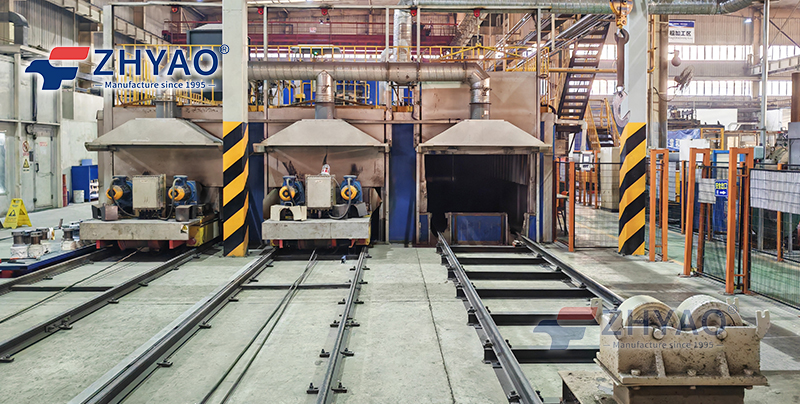
Floor conveyors are often worth considering for large welded frames, heavy machinery components, pressure vessels, and oversized fabricated parts that are easier to support on a platform or skid.
A floor conveyor can distribute the load through a purpose-designed carrier and its supporting wheels or rollers. This can provide a practical handling arrangement when suspending the product would be difficult.
The decision should begin with the workpiece's weight, dimensions, center of gravity, lifting points, and required transport orientation.
2. Compare Load Capacity and Structural Requirements
Both conveyor types must be designed for the actual operating load. Neither is automatically suitable for heavy workpieces simply because of its basic structure.
For an overhead conveyor, the load calculation should include the workpiece, hanger, fixture, and other moving components supported by the system. The track, chain, drive components, support structure, and building connections must be suitable for the specified loading conditions.
For a floor conveyor, the design must account for the workpiece, carrier or skid, load distribution, wheel or roller loads, drive capacity, and track or floor conditions.
There is also an important difference in how each system transfers loads to the factory structure.
An overhead system transfers loads through its supporting structure and building connections. The existing building must be verified as suitable for these loads; its roof or ceiling should not be assumed capable of supporting a heavy conveyor.
A floor conveyor transfers loads through its wheels, rails, or rollers to the supporting floor structure. The floor and track foundation must be suitable for the concentrated loads and operating conditions.
Before comparing quotations, ask each supplier to specify the design load per hanger or carrier, the intended loading arrangement, and any building reinforcement or foundation requirements.
3. Evaluate the Available Factory Space
Factory layout can influence the conveyor choice as much as workpiece weight.
An overhead conveyor can make efficient use of vertical space and keep much of the floor available for forklifts, operators, and other production activities. It may be practical when products can be suspended and the building provides sufficient clearance.
However, the available height must accommodate the conveyor track, hanger assembly, workpiece dimensions, and movement through the production line. Tall or wide workpieces may also require special attention to turning clearance and interference with equipment.
A floor conveyor occupies part of the working floor and may affect forklift routes, material storage, and operator access. On the other hand, it can be a practical option when the building has limited overhead clearance or when large products are easier to load at floor level.
Existing columns, doors, floor levels, and maintenance access should also be considered.
A layout that accommodates the conveyor itself may still be unsuitable if the workpiece cannot be loaded, turned, transferred, or unloaded efficiently.
4. Consider Loading, Unloading, and Product Changes
The conveyor should match the factory's material-handling method, not just the coating process.
Overhead systems work well when products can be loaded onto hangers using an appropriate manual or mechanical lifting arrangement. Once loaded, workpieces can move through the line while the floor remains relatively clear.
For very heavy parts, however, loading and unloading may require lifting equipment, dedicated loading stations, and sufficient clearance for safe positioning. The handling cycle can become a production constraint if each part takes a long time to secure or remove.
Floor conveyors can simplify handling when products are loaded directly onto carriers or skids. Depending on the design, forklifts, hoists, or other lifting equipment may be used to position the workpieces.
Customized carriers can also accommodate products with different shapes, although frequent changes in product dimensions may require adjustments to the support fixtures.
If the factory processes a wide range of heavy workpieces, evaluate how easily the system can accommodate different sizes, weights, and loading positions. A conveyor designed around one product may become restrictive when the product range expands.
5. Match the Conveyor to the Coating Process
A conveyor must do more than transport a workpiece. It must also support the requirements of spraying, curing, and any other processes included in the production line.
For overhead conveying, the hanger arrangement affects workpiece orientation, spacing, and access to the surfaces being coated. Heavy or irregular parts may require specially designed fixtures to provide stable support and adequate clearance during spraying.
For floor conveying, the carrier or skid must position the workpiece securely and consistently. Its design should not unnecessarily obstruct the surfaces that need coating or interfere with equipment along the process route.
The curing stage also needs careful evaluation. The conveying system must accommodate the workpiece's dimensions, weight, and required processing time. Oven clearance, loading arrangements, thermal conditions, and conveyor operation should be considered together.
For continuous production, the conveyor should support the required production rhythm without compromising spraying access or curing requirements. For intermittent or batch-based processing, the system may need controlled positioning and sufficient space for loading, unloading, or temporary holding.
The appropriate solution depends on the complete process, not on the conveyor type in isolation.
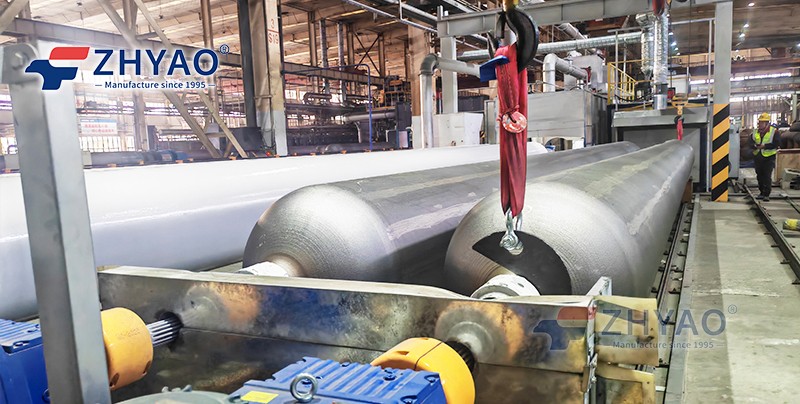
6. A Real Project Example: Floor Rail Conveying for a Pressure Vessel Coating Line
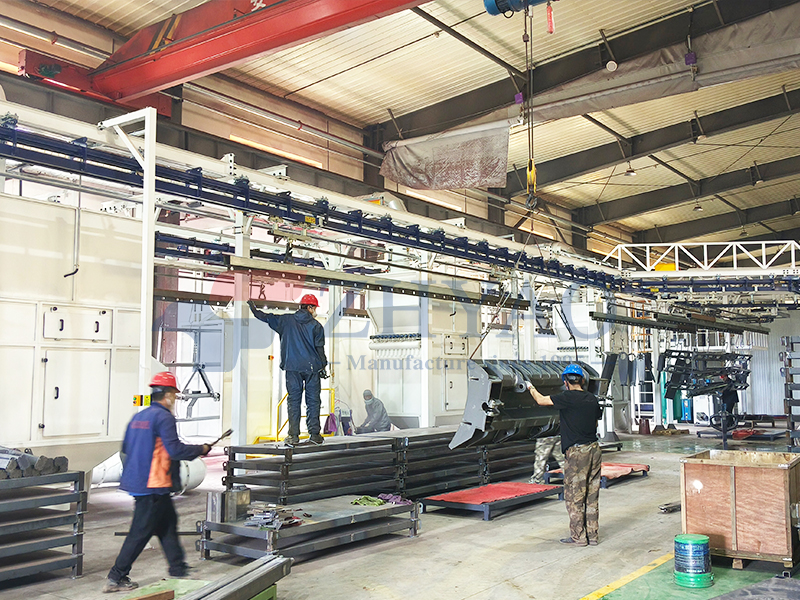
In China, ZHYAO provided a coating line for CIMC ENRIC, a manufacturer of pressure vessels and related equipment. The project used a floor rail conveying system to transport workpieces through the coating process.
Pressure vessels can present particular handling challenges because of their dimensions, weight distribution, curved surfaces, and support requirements. The conveying arrangement must suit the actual workpiece while allowing operators to access the surfaces that require coating.
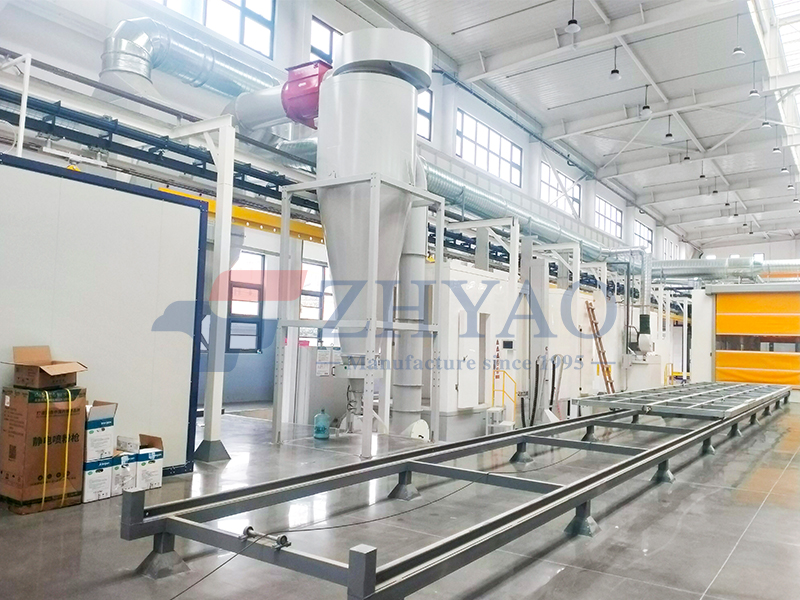
A floor rail system provides a defined travel path for purpose-designed carriers, making it an option worth evaluating for large industrial components that are difficult to suspend. Its suitability still depends on the load, carrier design, track layout, and factory conditions.
This project illustrates why conveyor selection should be based on the product being handled and the requirements of the coating process, rather than workpiece weight alone. For manufacturers planning a coating line for heavy products, the support method, loading arrangement, available floor space, and process layout should all be considered before the conveying system is finalized.
7. How Should Buyers Compare the Two Options?
The following comparison provides a starting point for supplier discussions.
Overhead conveyor
Suitable when workpieces can be securely suspended, sufficient vertical clearance is available, and keeping the floor clear is important.
Key points to verify include hanger design, suspended load capacity, building support requirements, lifting access, and workpiece clearance.
Floor conveyor
Suitable when workpieces are easier to support from below, require dedicated carriers, or are difficult to suspend safely.
Key points to verify include carrier design, wheel and track loading, floor conditions, loading access, and interference with other floor activities.
Neither option is universally better. A properly engineered overhead conveyor can handle heavy products effectively, while a floor conveyor may be more practical for products that require substantial support from below.
The comparison should also include installation costs, maintenance access, material-handling equipment, and the possibility of introducing larger or heavier products in the future.
8. What Should Be Confirmed Before Requesting a Quotation?
To obtain a meaningful conveyor proposal, prepare the following information:
Maximum and typical workpiece weight.
Workpiece length, width, and height.
Center of gravity and available lifting or support points.
Required loading and unloading method.
Expected production volume and operating hours.
Required coating and curing processes.
Available factory dimensions, ceiling height, and floor conditions.
Product variety and anticipated future changes.
Ask suppliers to explain the basis of their proposed load capacity and identify any additional structural, lifting, or foundation requirements.
When comparing quotations, make sure the proposed systems are based on the same workpiece conditions and production expectations. A lower initial price may not represent a lower total project cost if additional building modifications, handling equipment, or carrier changes are required.
The most suitable conveyor is the one that safely handles the intended workpieces and integrates effectively with the production process.
FAQ
Q1: Is a floor conveyor always better for heavy workpieces?
No. A floor conveyor can be advantageous for products that are difficult to suspend, but a properly engineered overhead conveyor can also handle heavy workpieces. The choice depends on load capacity, workpiece geometry, support method, building structure, and handling requirements.
Q2: What information is needed to select a conveyor for a heavy-duty coating line?
The main requirements include workpiece weight and dimensions, center of gravity, lifting or support points, production volume, loading method, factory layout, and curing conditions. These details help the supplier evaluate the conveyor structure, carrier design, and integration with the coating process.
- Previous:How Factory Space and Layout Affect Powder Coating Line Design
- Next:High-Efficiency Powder Coating



 customer service