
- When Should You Invest in an Automatic Powder Coating Line?
- Powder Coating Lines: Can They Be Customized to Meet Different Production Requirements?
- Turnkey Powder Coating Solutions: How to Avoid Hidden Costs and Project Delays
- Best Powder Coating Line Configuration for Factories: How to Match Equipment to Production Needs
- How to Compare Different Powder Coating Line Quotations
phone:+8618533267656
WhatsApp:+8618032661886
Email:info@powder-coatingline.com
Address:No. 55, Airport Road, Changshou Street, Xinle City, Shijiazhuang, Hebei Province
How to Design a Spray Painting Line for Different Metal Parts
When a factory needs to spray paint different types of metal parts, the main challenge is not simply choosing a spray booth or conveyor. It is designing a production line that can handle product variations without creating unnecessary adjustments, coating defects, or production delays.
Metal brackets, machine components, metal housings, and diamond saw blades have different shapes, surface areas, and handling requirements. A painting line designed around one product may not work equally well for another.
The right design starts with understanding the products, identifying which requirements they share, and determining where different handling or spraying arrangements are necessary.
1. Start With the Differences Between Your Products
Before selecting equipment, group the products according to their dimensions, weight, shape, and coating requirements.
For example, flat metal components may be relatively easy to position for spraying, while irregularly shaped parts can have recessed areas, edges, and surfaces that are difficult to reach. Small hardware components may require dedicated fixtures to maintain consistent spacing, whereas larger parts need sufficient clearance throughout the line.
These differences affect more than the spray booth. They can also influence conveyor loading, fixture design, spray gun positioning, drying arrangements, and the time required to process each product.
A useful first step is to identify the products that share similar production requirements. If several parts can use the same handling method and coating arrangement, they may be suitable for the same production line. Products with substantially different requirements may need adjustable fixtures, separate processing arrangements, or dedicated equipment.
2. Design the Hanging and Positioning Method Around the Workpiece
Workpiece positioning is one of the most important considerations when designing a painting line for different metal parts.
The fixture must hold each part securely during transport and spraying while exposing the surfaces that need coating. If a part moves, tilts, or changes orientation during production, coating consistency can become difficult to maintain.
For flat or regularly shaped components, a relatively simple fixture may be sufficient. Parts with complex geometries may require customized supports to maintain the correct orientation and provide access to critical surfaces.
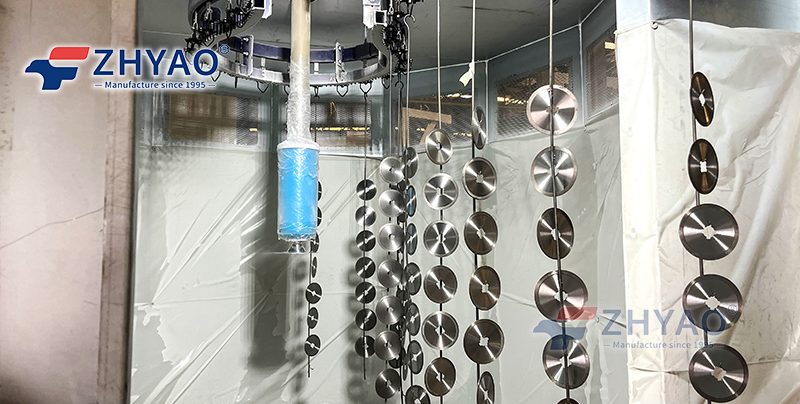
Diamond saw blades are a useful example. Their disc-shaped structure and central opening create different positioning considerations from those of brackets, frames, or metal housings. The loading method and fixture arrangement should suit the blade dimensions and the surfaces that require coating.
For factories handling multiple product types, fixture flexibility should be evaluated early. A system that can accommodate several products may reduce the need for separate handling arrangements, but excessive adjustability can also complicate loading and changeovers.
The goal is to achieve reliable positioning without making routine production unnecessarily complicated.
3. Match Spray Gun Coverage to Product Geometry
Different metal parts require different spray gun positions and coverage arrangements.
Flat surfaces may allow relatively straightforward spray gun positioning. However, recessed areas, edges, narrow gaps, and irregular profiles can create areas that receive less coating than expected.
When products vary in size or shape, a spray gun arrangement that works well for one part may produce uneven coverage on another. The solution may involve adjusting gun positions, changing the number or orientation of spray guns, modifying workpiece spacing, or retaining manual spraying for areas that require additional attention.
The appropriate arrangement depends on the coating material, required finish, part geometry, and production conditions.
Before finalizing the design, suppliers should understand which surfaces must be coated, whether both sides require treatment, and whether appearance or film thickness requirements differ between product types.
Where necessary, representative workpieces should be used to evaluate coverage before the final configuration is confirmed.
4. Consider Product Variety When Planning Conveyor Capacity
A conveyor system must accommodate not only the weight and dimensions of the products but also the time required to load, unload, and spray them.
When a line processes different metal parts, the largest product may determine the minimum clearance, while the heaviest product may determine the required load capacity. Neither factor alone establishes the required production rate.
Product spacing is another important consideration. Larger workpieces may need more room to avoid interference, while smaller parts may allow closer spacing if spraying access and coating quality are maintained.
Different products may also require different handling times. A part that is easy to load and spray may move through production more quickly than one requiring careful positioning or additional manual work.
For this reason, production capacity should be evaluated using the actual product mix rather than the number of workpieces alone.
If the factory processes several product types in different quantities, suppliers should understand the expected production volume for each group. This helps determine whether one shared line is practical or whether separate processing arrangements would provide better operational flexibility.
5. Plan for Product Changes and Color Changes
Frequent product changes can affect production efficiency even when the painting equipment has sufficient capacity.
Changing from one part to another may require new fixtures, different spray gun positions, adjustments to conveyor loading, or changes to operating settings. If these adjustments take too long, the factory may lose a significant amount of production time.
Color changes introduce additional considerations, particularly when the process requires cleaning equipment or managing different coating materials.
The line design should therefore consider how often products change, how many coating colors are used, and which adjustments can be completed quickly and consistently.
For a factory producing several related metal components, standardized fixtures and clearly defined changeover procedures may be sufficient. For a factory handling products with substantially different geometries, a more flexible arrangement or separate production zones may be worth evaluating.
The best solution depends on the frequency and complexity of these changes, not simply on the total number of product types.
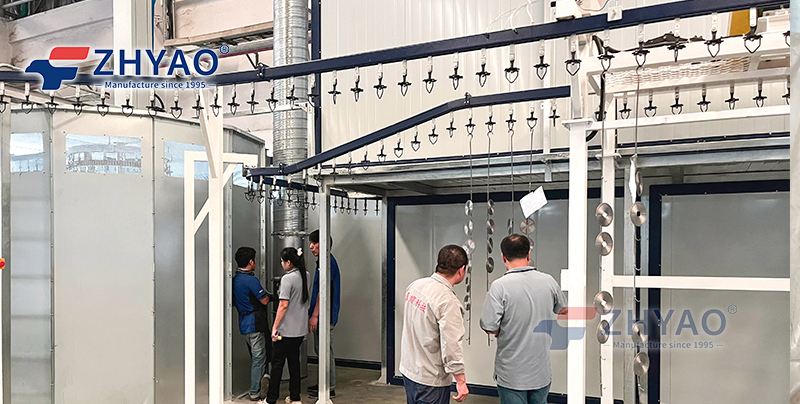
6. Real Project Example: Spray Painting Line for Diamond Saw Blades in Thailand
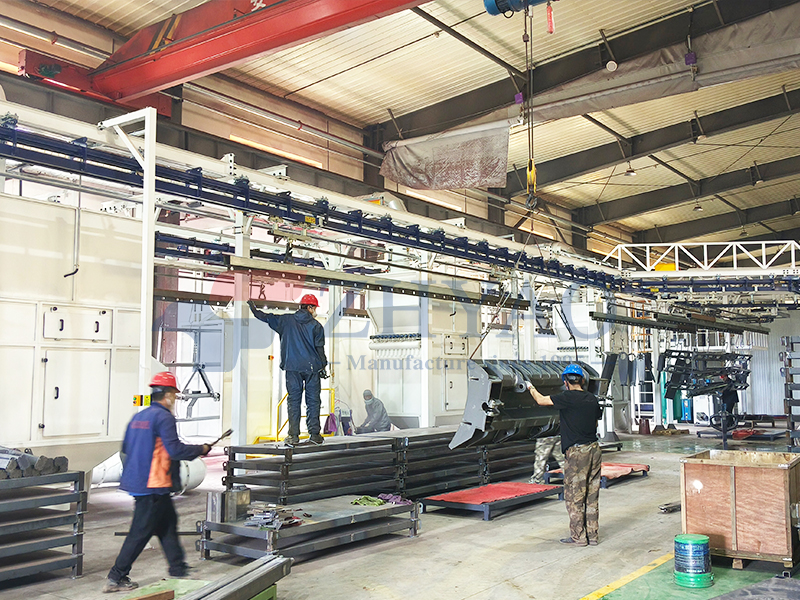
ZHYAO supplied a spray painting line for diamond saw blades in Thailand. This project illustrates the importance of considering the actual product when planning a painting system for metal components.
Diamond saw blades have a different shape and surface layout from many conventional hardware products. Their positioning, handling, and coating access therefore need to be considered in relation to the specific production requirements.
For factories processing different metal components, the same principle applies: equipment selection should begin with the workpiece rather than a standard equipment list. Understanding product dimensions, geometry, loading requirements, and coating specifications helps establish a more suitable production line configuration.
Although different products may share the same basic painting process, their handling and spraying requirements can vary considerably. These differences should be evaluated before deciding whether one line can serve all products effectively.
7. Should Different Metal Parts Share One Painting Line?
Using one line for multiple products can reduce equipment duplication and make better use of available factory space. However, sharing a line is practical only when the products' requirements are sufficiently compatible.
A common line is worth considering when products can use similar conveying arrangements, fit within the available working space, and achieve the required coating quality with manageable adjustments.
Separate processing arrangements may be more appropriate when products require substantially different handling methods, coating materials, production conditions, or levels of cleanliness.
The decision should also account for production volume. If one product group requires continuous, high-volume production while another is produced in small batches with frequent changes, a shared line may create scheduling conflicts.
Before making a decision, compare the cost and complexity of a flexible shared system with the investment and operating requirements of separate lines. The objective is not to process every product on one line at any cost, but to establish a system that meets production needs without unnecessary complexity.
8. What Information Should You Prepare Before Requesting a Quotation?
To help suppliers develop a suitable spray painting line proposal, prepare the following information:
Product drawings, photographs, or representative samples.
Minimum and maximum workpiece dimensions and weights.
The surfaces that require coating and the required finish.
Coating material specifications and applicable drying or curing requirements.
Expected production volume for each product type.
Typical batch sizes and product changeover frequency.
Color-change requirements, if applicable.
Available factory space and existing material-handling conditions.
If some product specifications are not yet finalized, provide the current range and identify the items that may change.
These details help suppliers assess whether a shared line is practical, which fixtures may be required, and how spraying and conveying arrangements should be configured. They also make quotations easier to compare because suppliers can work from the same production assumptions.
FAQ
Q1: Can one spray painting line handle different types of metal components?
Yes, provided the products have compatible handling, spraying, and drying requirements. Adjustable fixtures and suitable spray gun arrangements can support product variation, but parts with substantially different requirements may need separate processing arrangements.
Q2: What is the most important factor when designing a spray painting line for multiple products?
Product compatibility is a key starting point. Dimensions, weight, geometry, coating requirements, and production volume determine whether products can share the same line efficiently and what adjustments are needed between production runs.
- Previous:How Factory Layout Constraints Affect Powder Coating Line Design
- Next:When Should You Invest in an A
-
2026-06-15How Much Does a Powder Coating Line Cost?



 customer service