
- When Is It Time to Upgrade a Manual Powder Coating Process?
- ZHYAO Successfully Delivers Customized Crutch Powder Coating Line for Zhipudun Medical Equipment Gro
- When Should You Invest in an Automatic Powder Coating Line?
- Powder Coating Lines: Can They Be Customized to Meet Different Production Requirements?
- Turnkey Powder Coating Solutions: How to Avoid Hidden Costs and Project Delays
phone:+8618533267656
WhatsApp:+8618032661886
Email:info@powder-coatingline.com
Address:No. 55, Airport Road, Changshou Street, Xinle City, Shijiazhuang, Hebei Province
Powder Coating Lines: Can They Be Customized to Meet Different Production Requirements?
A powder coating line can be customized to suit different products, production targets, and factory conditions. In many industrial projects, customization is not simply a matter of changing equipment dimensions. It means designing a production system around the workpieces being coated and the way the factory needs to operate.
A standard configuration may be suitable for products with consistent dimensions and stable production volumes. However, manufacturers handling large workpieces, multiple product types, limited workshop space, or changing production demands may need a different arrangement.
The important question is not whether a powder coating line can be customized, but which parts should be customized and which requirements should determine the design.
1. Product Characteristics Determine the Starting Point
The products being coated are usually the first consideration when designing a customized powder coating line.
Dimensions, weight, shape, material, and surface structure influence how workpieces are transported, pretreated, sprayed, and cured.
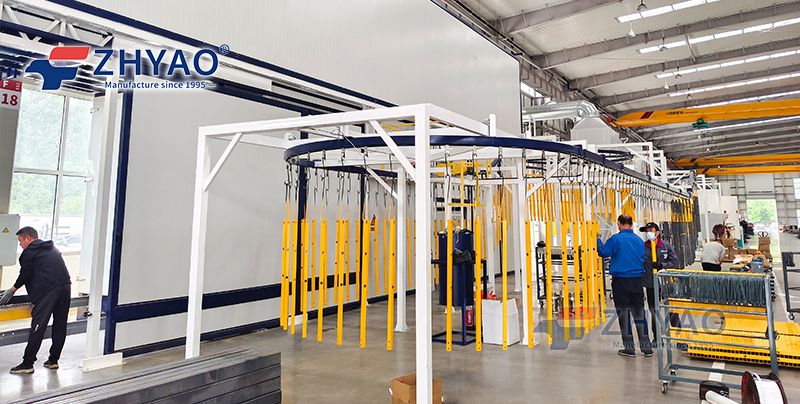
For example, long aluminum profiles require sufficient conveyor clearance and suitable hanging arrangements. Large steel structures may need heavier-duty handling equipment and a different booth layout. Small metal components produced in batches may benefit from multi-piece hanging arrangements, provided that the required coating coverage can be achieved.
Complex workpiece shapes also affect spray gun positioning and powder accessibility. Recessed areas, corners, and internal surfaces may require particular attention during process and equipment selection.
These differences mean that customization should begin with the actual product range rather than a predefined equipment list.
2. Production Capacity Should Shape the Line Configuration
Two factories coating similar products may still require different production lines because their output targets and operating patterns differ.
A manufacturer producing a relatively small number of large components may prioritize handling flexibility and reliable coating quality. A factory producing high volumes of smaller parts may place greater emphasis on conveyor speed, loading density, and consistent process timing.
Production capacity depends on more than the nominal speed of the conveyor. Workpiece spacing, loading and unloading time, curing requirements, color changes, and equipment availability all influence the output that can be achieved in practice.
A customized design should therefore connect the required output with the entire production process. Increasing conveyor speed alone will not necessarily increase finished-product output if the curing oven, loading area, or spraying process becomes the limiting factor.
3. The Factory Layout Can Change the Equipment Arrangement
Available factory space is another reason to customize a powder coating line.
Some factories have sufficient floor space for a straight-through layout. Others must work around existing machinery, structural columns, access routes, or limited building height.
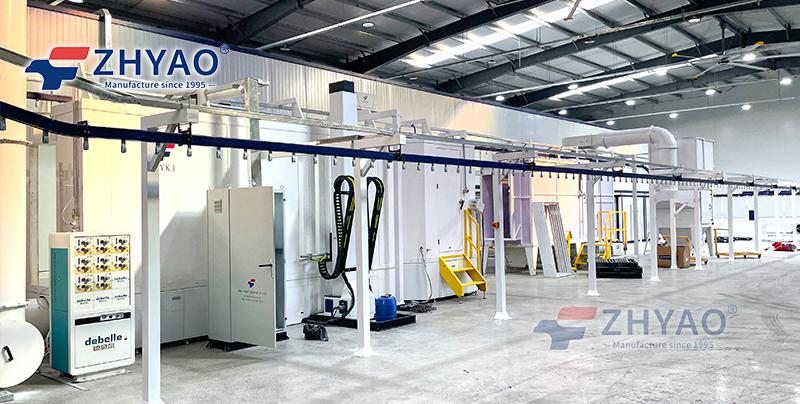
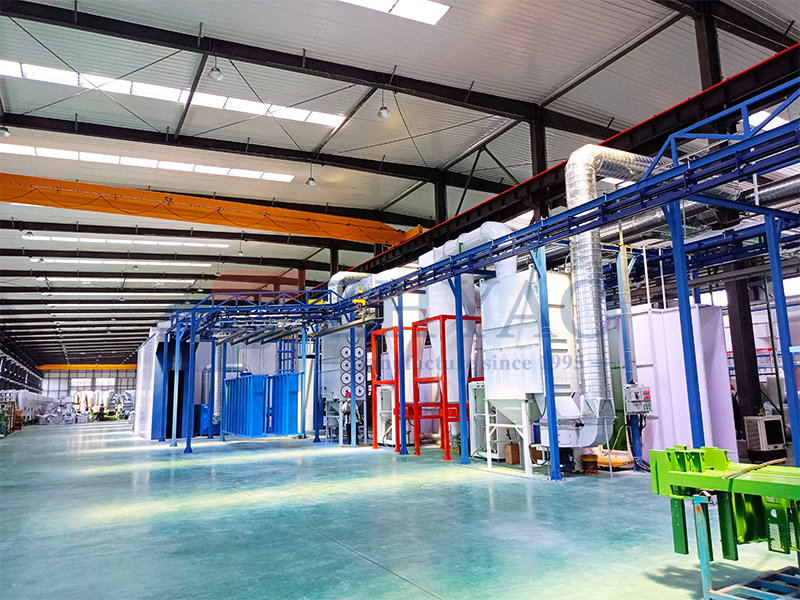
Depending on the site conditions, a line may use a straight, U-shaped, or other suitable arrangement. Conveyor routing, oven placement, maintenance access, and material flow should be considered together.
However, fitting equipment into the available space should not be the only objective. An overly compact layout may make maintenance difficult, restrict workpiece movement, or create bottlenecks between production stages.
The better approach is to evaluate the workshop layout alongside the production process, identifying which constraints can be accommodated and which may require changes to the proposed design.
4. The Pretreatment and Curing Processes Must Match the Coating Requirements
Customization also applies to the process itself, not just the mechanical arrangement of the equipment.
Different products and coating specifications may require different surface preparation methods. Depending on the material, contamination, corrosion protection requirements, and final coating specification, the pretreatment process may involve cleaning, rinsing, conversion treatment, or other suitable preparation methods.
The curing system must also be selected according to the powder manufacturer's requirements and the workpiece characteristics. The relevant curing condition is the actual part temperature over the required time, not simply the temperature displayed by the oven controller.
Workpiece thickness, mass, loading density, and oven circulation can influence heating behavior. A customized oven design should account for these factors to help achieve the required curing conditions throughout the production load.
Selecting pretreatment and curing equipment without considering the products and coating requirements can lead to a line that operates mechanically but struggles to deliver consistent coating quality.
5. Automation Can Be Customized Without Automating Every Process
A customized powder coating line does not necessarily need to be fully automatic.
The appropriate automation level depends on production volume, product consistency, labor availability, color-change frequency, and investment priorities.
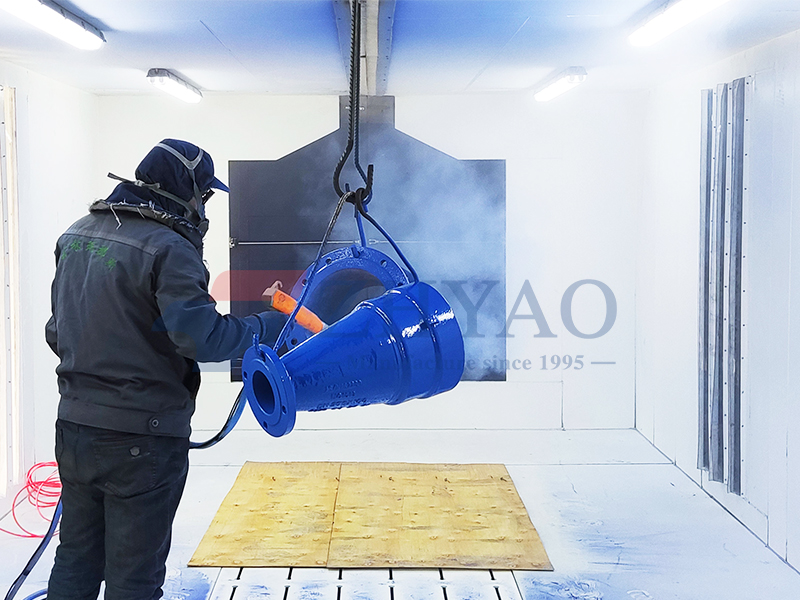
Manual spraying may offer flexibility for small batches and frequently changing workpieces. Automatic spray guns and reciprocators may be suitable for more consistent production. Robotic spraying can be considered for complex geometries or applications requiring programmable spray paths, provided that the products, process, and handling system support effective automation.
Loading, unloading, conveying, spraying, powder recovery, and control functions can also be evaluated separately.
For some factories, automating the spraying process while retaining manual loading and touch-up operations provides a practical balance between productivity and flexibility. For others, a higher level of integration may be justified by stable, high-volume production.
The goal is to select automation that addresses a real production constraint rather than adding automated equipment that the factory cannot fully utilize.
6. What Information Is Needed for a Customized Quotation?
A supplier can usually develop a more relevant proposal when the initial project information describes both the products and the intended production process.
Useful information includes:
Product photos, drawings, or representative samples
Workpiece dimensions, weight, and material
Required coating finish and quality expectations
Target production output and operating schedule
Powder colors and expected color-change frequency
Existing pretreatment, spraying, or curing equipment, if any
Factory layout, available dimensions, and building height
Available utilities and preferred automation level
Not every detail must be finalized before the first discussion. If production targets or process requirements are still being evaluated, the supplier should identify the assumptions used in the preliminary proposal and clarify which decisions require further confirmation.
This helps distinguish a genuinely customized solution from a standard equipment package with only minor adjustments.
7. Customization Should Solve Problems, Not Simply Add Features
A customized powder coating line may involve additional engineering, specialized handling equipment, non-standard dimensions, or more complex control functions. These changes can affect the initial investment, manufacturing schedule, installation requirements, and future maintenance.
For this reason, customization should be based on clearly defined production needs.
Before approving a proposal, confirm which design features are essential, which are optional, and how each major choice affects operation. Also consider whether standard components can meet the requirement without unnecessary complexity.
The most suitable solution is not necessarily the most automated or the most extensively customized one. It is the configuration that meets the required coating quality and production output while fitting the factory's operating conditions and budget.
FAQ
1. Can a powder coating line be customized for different types of products?
Yes. A powder coating line can be designed or configured around different workpiece dimensions, weights, shapes, production volumes, and coating requirements. When a factory handles several product types, the design should also consider changeover time, handling flexibility, and whether all products can share the same pretreatment and curing processes.
2. Is a customized powder coating line more expensive than a standard line?
Not necessarily in every case, but specialized dimensions, handling systems, automation, and process requirements can increase the initial investment. A customized design may also avoid unnecessary equipment or modifications after installation. The cost should be evaluated against the actual production requirements rather than customization alone.
- Previous:Turnkey Powder Coating Solutions: How to Avoid Hidden Costs and Project Delays
- Next:When Is It Time to Upgrade a M



 customer service