
- How to Plan a Powder Coating Line Layout
- How to Select a Powder Coating Booth for Industrial Production
- How to Choose an Automatic Powder Coating Line Based on Production Capacity
- How to Choose the Right Powder Coating System for Metal Parts: Key Buying Decisions
- Manual vs. Automatic Powder Coating Lines: When Is Automation Worth the Investment?
phone:+8618533267656
WhatsApp:+8618032661886
Email:info@powder-coatingline.com
Address:No. 55, Airport Road, Changshou Street, Xinle City, Shijiazhuang, Hebei Province
How to Select a Powder Coating Booth for Industrial Production
Powder drifting out of the booth openings, color specks ruining a white finish, recovery filters loading up in two hours instead of two days — when a powder line underperforms like this, the gun is rarely the first thing to check. More often than not, the booth was sized or configured wrong for the job from day one, and the plant has been paying for it ever since in rework, wasted powder, and maintenance hours.
If you're specifying a booth for a new line or replacing an old one, here's how the decision actually breaks down in practice.

Powder Coating Booth Sizing: Start With Your Parts, Not the Catalog
Before comparing booth models, write down three things: your largest part envelope (height, width, depth), your daily color changes, and your powder types. A booth that works well for single-color steel brackets will frustrate you if you run twelve colors a day on aluminum extrusions.
The part envelope is the starting point for the booth opening and internal clearances — but it is not the whole calculation. Final clearances also need to account for the gun motion range, part sway and rotation on the conveyor, hook and rack geometry, and the air passages that keep flow even around the surface. As a design starting point, many layouts aim for roughly 300–400 mm of free space around the part, but that figure only means something once it is confirmed against the actual gun-to-part distance and airflow design for your application. If parts hang on a conveyor, add the hook length and the wear allowance — hooks stretch, racks sag.
Open Booth or Enclosed Booth?
This is the first fork in the road.
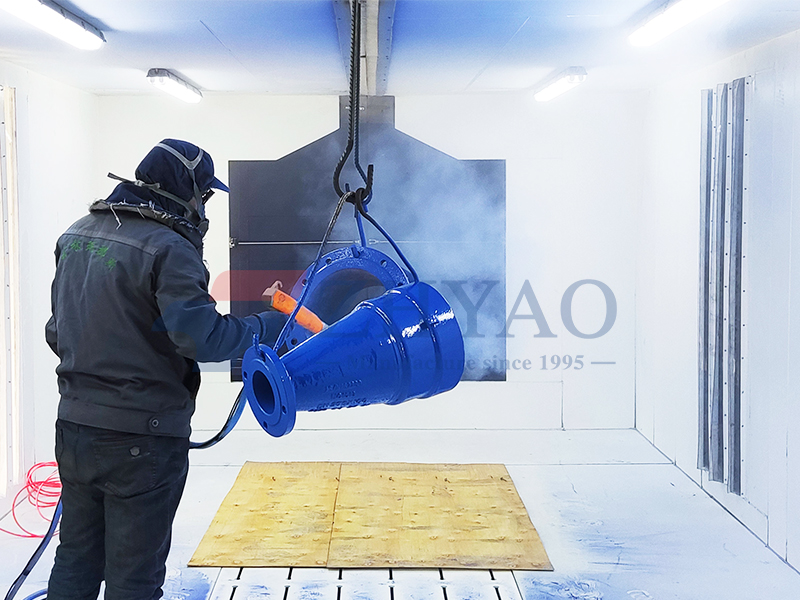
Open-face booths suit wide, flat, or awkward parts that an operator loads by hand, and they handle long conveyor sections without awkward tunnel transitions. Enclosed booths wrap the spray zone on three sides with only conveyor openings and access doors, keeping powder where it should be. The trade-offs line up like this:
Open-face booth | Enclosed booth | |
Best for | Hand-loaded, flat or irregular parts | Conveyor lines, multi-color production |
Powder containment | Lower, more housekeeping | High, overspray stays inside |
Recovery efficiency | Moderate | High |
Footprint / initial cost | Smaller / lower | Larger / higher |
Color change | Harder to keep clean | Cleaner, suits quick-change design |
If you run multiple colors — especially light over dark — an enclosed booth with fast color-change design usually pays for the difference within the first year.
Powder Coating Booth Airflow Must Be Designed for the Application
Booth performance lives and dies on airflow. Two aspects matter:
- Containment velocity at the booth openings. Published equipment data and standards such as NFPA 33 work with face velocities in the region of 0.3–0.5 m/s as a common design range, but the right value for your booth depends on the opening size, extraction arrangement, and whether spraying is manual or automatic.
- Airflow distribution — an even downward flow across the spray zone, without dead corners where powder recirculates.
Airflow has to do two jobs at once: pull overspray toward the recovery system, and leave the charged powder already depositing on the part undisturbed. Push the velocity too high and you can interfere with deposition and wrap; too low and powder escapes into the workshop. Gun settings, part grounding, spray distance, and part geometry all interact with booth air here, which is why a single velocity target should never be copied between projects. When you evaluate a supplier, ask for the airflow uniformity across the booth cross-section, not just the fan rating — this is a question we take seriously at ZHYAO when we size the fan and plenum around a customer's specific part profile.
Powder Booth Recovery Systems: Match the System to Your Production
Recovery choice drives both powder savings and color-change speed. Rather than a simple "few colors vs many colors" split, the better approach is to match the system to how you actually produce:
Production profile | What to focus on when selecting |
Single or few colors, long batches | Cartridge recovery: investment, filter maintenance, and whether reclaimed powder quality meets your reuse requirements |
Many colors, frequent changes | Ease of cleaning, how thoroughly the recovery path purges, and how colors are kept separated |
Small batches, trials, R&D | Equipment cost, cleaning time, and acceptable powder loss |
Cartridge recovery filters overspray directly into self-cleaning cartridge modules and returns recovered powder to the feed hopper. Suppliers commonly quote recovery rates of 90% or higher for overspray collection — but collection efficiency is not the same as reusable powder, and the real number depends on your powder, your color schedule, and how the system is configured.
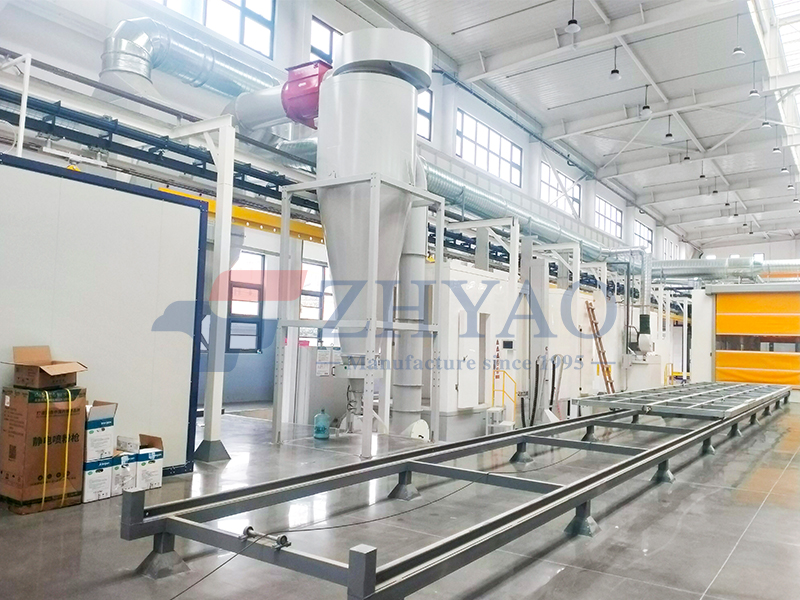
Cyclone recovery spins powder out of the air stream and suits multi-color operations, because each cyclone or collection container can be dedicated to a color. Note that a cyclone is not a standalone system — it always works with downstream after-filtration, so plan the headroom and floor space accordingly.
Filter-only (no reclaim) booths are still legitimate for short runs, trials, or shops that spray one low-cost powder and don't reclaim — don't pay for recovery you can't use.
If your color-change log shows more than three or four changes a day, prioritize a quick color-change booth design: removable back walls or hoppers, angled floors with no powder traps, and purge sequences that clear the recovery path in minutes rather than hours.
Construction Materials
The booth shell choice follows your powder chemistry, cleaning method, and budget:
- Galvanized steel — economical, fine for standard epoxies and polyesters.
- Stainless steel — the safe pick for corrosive powders, high-moisture environments, or frequent washdowns.
- PP (polypropylene) or PVC panels — popular on modern fast-change booths. Powder doesn't bond to it and wiping down between colors takes minutes. Because plastic is non-conductive, check how the supplier handles grounding design and safety requirements on these models.
Safety Requirements Depend on the Installation and Local Regulations
Powder is combustible dust, and the requirements are not identical everywhere. Confirm the applicable fire, electrical, ventilation, and combustible-dust rules for your market before specifying anything — in North America this typically means NFPA 33 and OSHA 29 CFR 1910.107; in Europe, the ATEX directives. Explosion venting or suppression is not a universal checkbox: whether such measures are required, and in what form, follows from the installation, the powder characteristics, and a risk assessment.
What should be universal in your specification: grounding of all conductive parts including hangers (poorly grounded hooks are also a film-build problem, not just a safety one), interlocks between the fan and the high-voltage system, and a supplier who can identify exactly which standards and compliance documents apply to the proposed system.
Questions to Ask Before You Sign
Whatever supplier you shortlist, put these on the table before the contract:
- Show me the airflow uniformity data across the booth cross-section — not just the fan's total m³/h rating.
- Demonstrate the color-change time on a booth configured like mine, following my color schedule — not a best-case demo.
- Which compliance documents ship with the recovery unit — applicable NFPA, OSHA or ATEX references, explosion-protection design where required, grounding scheme?
- Where does powder collect? Any flat floor, ledge, or hopper corner without an angle is a color-contamination trap you'll clean forever.
- How does the booth interface with my conveyor and oven? Ask for a line layout drawing before you sign, not after.
A supplier who answers these without hedging is worth a second conversation. One who dodges them has told you everything you need to know.
Don't Buy the Booth, Buy the Line
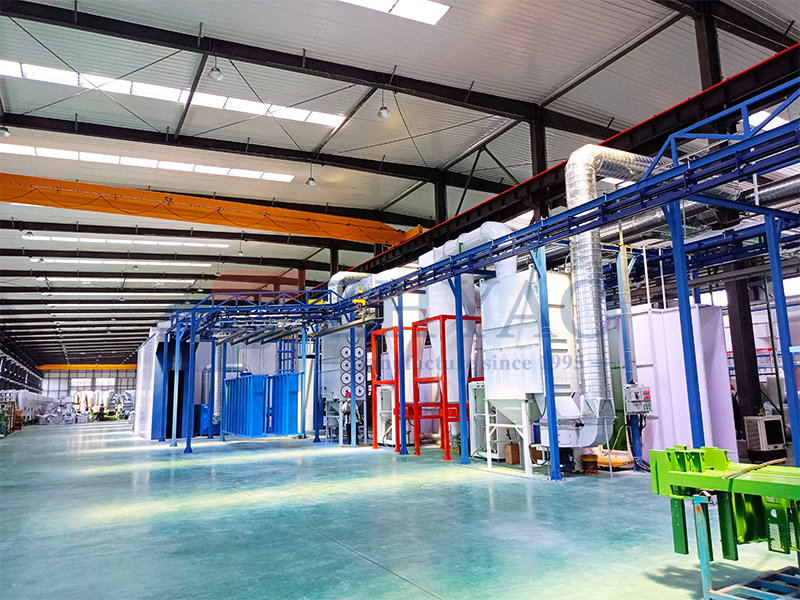
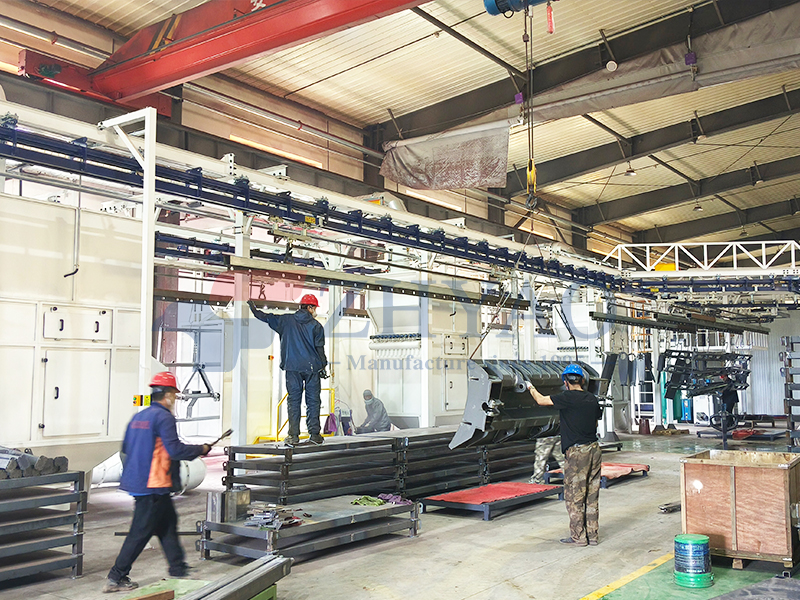
One last point: the booth never operates alone. Gun position, conveyor speed, curing oven temperature profile, and hook condition all interact with booth performance. When we build a hoist or overhead conveyor powder line at ZHYAO, booth sizing starts from the customer's part mix and production target, then the recovery, guns, and conveyor are specified around it — not the other way around. On a recent line for a fence post manufacturer, that sequence was what kept the whole color cycle inside a single shift.
If you're weighing booth options for a specific part range or production volume, send us the part drawings and your color schedule — we'll come back with a line layout and honest feedback on which booth configuration fits. You can also browse our completed powder coating line projects to see how these choices play out on real production floors.
FAQ
1. What size powder coating booth do I need for my parts?Start from your largest part envelope, then add space for gun motion range, part sway, hook and conveyor geometry, and airflow passages. Roughly 300–400 mm of free space around the part is a common design starting point, but final clearances should be confirmed by the booth and airflow design for your specific application.
2. What is the correct airflow velocity for a powder coating booth?Face velocities in the region of 0.3–0.5 m/s are a common design range for booth openings, but the right value depends on opening size, extraction arrangement, and spray method. Airflow uniformity across the booth cross-section matters as much as the average velocity — evaluate both under your actual operating conditions.
3. Cartridge or cyclone recovery — which is better?Neither is universally better. Cartridge recovery is compact and suits single- or few-color production with long batches; cyclone recovery keeps each color's reclaim separate and suits multi-color production, always with downstream after-filtration. If you change colors frequently, prioritize a quick color-change booth design regardless of recovery type.
- Previous:How to Choose the Right Powder Coating System for Metal Parts: Key Buying Decisions
- Next:How to Plan a Powder Coating L
-
2026-10-29How to Plan a Powder Coating Line Layout



 customer service