
- How to Choose an Automatic Powder Coating Line Based on Production Capacity
- How to Choose the Right Powder Coating System for Metal Parts: Key Buying Decisions
- Manual vs. Automatic Powder Coating Lines: When Is Automation Worth the Investment?
- What Size Powder Coating Line Do You Need? How to Match Equipment Investment to Production Demand
- When Is It Time to Upgrade a Manual Powder Coating Process?
phone:+8618533267656
WhatsApp:+8618032661886
Email:info@powder-coatingline.com
Address:No. 55, Airport Road, Changshou Street, Xinle City, Shijiazhuang, Hebei Province
How to Choose an Automatic Powder Coating Line Based on Production Capacity
Choosing an automatic powder coating line based on production capacity requires more than estimating how many parts a factory needs to produce each day. The line must handle the actual product mix, maintain the required coating quality, and keep every process stage operating at a compatible rate.
A system designed around an unrealistic output target may create bottlenecks in pretreatment, spraying, or curing. On the other hand, purchasing a line with excessive capacity can increase equipment costs, energy consumption, and maintenance requirements without delivering a meaningful production benefit.
The right approach is to calculate the required output first, then determine how the entire coating process must be configured to achieve it.
1. Start With Actual Production Targets, Not Maximum Theoretical Output
Before comparing equipment quotations, define the production target in practical terms.
For example, a factory may need to coat 800 metal components per shift. However, the equipment required depends on the size and shape of those components, the number of parts loaded on each hanger, the working hours available, and the time lost during color changes and routine interruptions.
Three capacity figures should be distinguished:
Required production output: The number of acceptable coated parts the factory needs to deliver.
Theoretical line capacity: The maximum output calculated under specified operating conditions.
Practical production output: The quantity the line can actually produce after accounting for loading, unloading, changeovers, downtime, and other operating constraints.
These figures are not interchangeable.
A line that theoretically handles the target volume may struggle to meet actual production requirements if the factory frequently changes products or colors. Capacity planning should therefore use realistic operating assumptions rather than the highest possible conveyor speed.
It is also important to distinguish between the number of workpieces and the coated surface area. Eight hundred small brackets and eight hundred large equipment housings can require very different spraying and curing capacities.

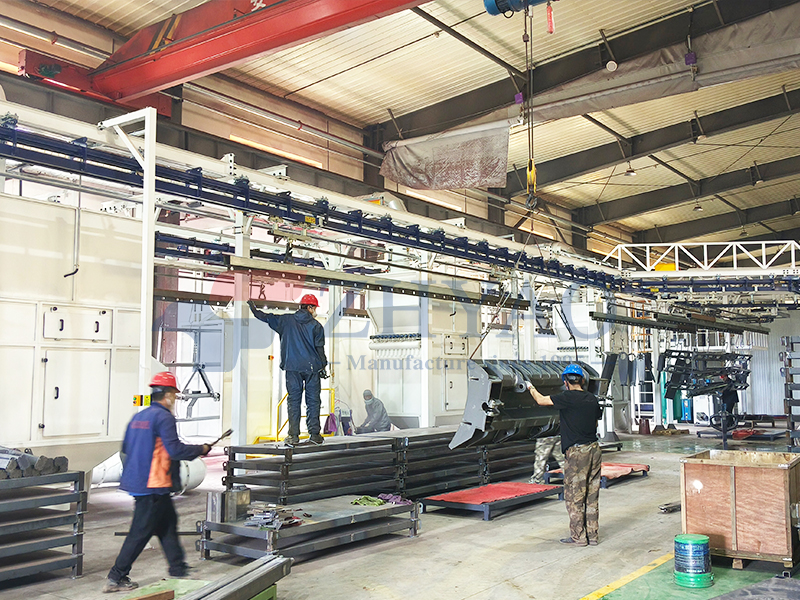
(Cable Tray Coating Production Line)
2. Convert the Production Target Into a Required Line Cycle
Once the production target and effective working time are known, the next step is to calculate the required production cycle.
For a line that processes one workpiece at a time, the basic calculation is:
Required cycle time = Effective production time ÷ Required output
Suppose a factory needs 800 acceptable parts during a shift and has 7 effective production hours available.
The average required output rate is approximately 114 parts per hour, equivalent to one acceptable part every 31.5 seconds.
This is a planning calculation, not a guarantee that the line can achieve the target. It assumes that the available production time and required output have already been defined consistently.
If multiple parts can be loaded onto one hanger, the calculation must also account for the number of parts per hanger and the spacing between hangers.
For example, when each hanger carries four comparable parts, the line may need to release approximately 29 fully loaded hangers per hour to support the same target. Actual loading arrangements must still allow sufficient clearance for spraying, drainage where applicable, and curing.
The required cycle helps establish an initial equipment configuration. It should not be used alone to determine conveyor speed because the relationship between speed and output depends on hanger pitch, loading density, and the product mix.
3. Match Conveyor Speed to Loading Density and Workpiece Dimensions
Conveyor design directly affects how products move through the coating line, but a faster conveyor does not automatically produce more acceptable parts.
For a continuously moving conveyor, a simplified theoretical capacity calculation is:
Theoretical output per hour = 3,600 ÷ Hanger interval time × Parts per hanger
Here, the hanger interval time is expressed in seconds. The calculation assumes a consistent loading pattern and does not account for downtime, rejected parts, or process limitations.
Alternatively, if conveyor speed and hanger pitch are known:
Hangers per hour = Conveyor speed per hour ÷ Hanger pitch
The resulting output must then be multiplied by the number of parts per hanger.
However, the hanger pitch cannot be selected independently of the workpieces.
Large panels, long profiles, and bulky fabricated components may require greater spacing to prevent interference between adjacent parts. Complex shapes may also need different orientations to improve electrostatic powder coverage and reduce shielding effects.
Increasing the spacing reduces the number of hangers passing through the line per hour. If the target output remains unchanged, the factory may need to increase the number of parts per hanger, use a different loading arrangement, or consider a different conveyor configuration.
Each option has practical limits. Overloading hangers can make spraying access more difficult, while unsuitable spacing can cause interference between parts or restrict airflow and heat circulation in the curing oven.
For this reason, conveyor speed, hanger pitch, fixture design, and workpiece dimensions should be evaluated as a connected system.

4. Check the Capacity of Every Process Stage
An automatic powder coating line operates as a connected production system. Its effective capacity is limited by the process stages that cannot support the required output.
Pretreatment and drying
Pretreatment capacity depends on the selected process, treatment stages, workpiece surface condition, and required processing time. A spray pretreatment line, for example, must provide sufficient treatment time and coverage for the relevant product range.
The drying stage must remove moisture before powder application. If parts leave the dryer inadequately prepared, coating defects may occur even when the spraying equipment has sufficient capacity.
Automatic powder spraying
Automatic spray guns and reciprocators can improve consistency and reduce repetitive manual work when product geometry and production conditions are suitable.
However, spray equipment capacity should be evaluated in relation to the actual parts being coated. Deep recesses, internal corners, welded joints, and complex geometries may require adjustments to gun positioning or additional manual touch-up.
A high conveyor speed is of limited value if the required coating coverage cannot be achieved consistently.
The curing oven is a particularly important capacity constraint because the coating must receive the specified curing conditions.
For a continuous oven, the approximate residence time is:
Residence time = Heated-zone length ÷ Conveyor speed
This simplified relationship assumes a constant conveyor speed through the relevant heated zone. Actual curing performance also depends on oven design, temperature distribution, workpiece mass, loading density, and the powder manufacturer's curing requirements.
If conveyor speed increases, residence time decreases unless the effective heated-zone length or process configuration changes. A higher output target therefore requires confirmation that the oven can still deliver the required curing conditions at the intended operating rate.
Loading, unloading, and handling
Manual loading or unloading can become the limiting stage even when the rest of the line has sufficient capacity.
The time needed to position heavy parts, attach fixtures, check orientation, and remove finished products should be included in the capacity assessment. Where these activities restrict production, improvements to handling arrangements may provide more value than upgrading the spray equipment.
The practical output of the complete line is determined by these interacting constraints, not by the nominal capacity of any single machine.
5. Choose the Automation Level That Matches Production Stability
The required output is important, but production stability and product variety also influence the appropriate automation level.
A semi-automatic configuration may be suitable when output requirements are moderate, products vary frequently, or operators need flexibility to handle complex workpieces.
A more highly automated line may be justified when production volumes are substantial, product dimensions are relatively consistent, and repetitive operations create significant labor or throughput constraints.
Before choosing full automation, consider:
Whether the product range is stable enough for repeatable automatic spraying
How much manual touch-up is still necessary
Whether automatic loading and unloading are justified
How often products, fixtures, or colors change
Whether maintenance and troubleshooting resources are available
Whether future production increases are reasonably predictable
A fully automatic system may reduce repetitive manual operations, but it also introduces additional control, maintenance, and integration requirements. For factories with frequent small-batch production, the setup and changeover demands may offset part of the expected productivity gain.
The objective is to automate the operations that genuinely constrain production rather than maximize automation for its own sake.
6. Compare Investment and Operating Costs
When comparing automatic powder coating line proposals, evaluate the total cost of achieving the required production output, not just the initial equipment price.
Consider equipment and installation costs, labor, energy consumption, powder recovery, maintenance, downtime, and future expansion. A higher-capacity line may be worthwhile for growing production volumes, but it can increase investment and operating costs if actual utilization remains low.
Ask suppliers to compare configurations using the same production targets, workpiece specifications, and operating assumptions.
7. Prepare Key Information for the Supplier
To obtain a suitable proposal, provide the supplier with:
Workpiece dimensions, weight, material, and product drawings or photos
Required output per shift and available working hours
Coating quality and curing requirements
Product variety and color-change frequency
Preferred automation level and loading method
Available factory space and utilities
Expected future production increases
Ask the supplier to explain the proposed conveyor speed, hanger spacing, curing capacity, and expected production output.
Accurate project information helps avoid undersized equipment, unnecessary investment, and production bottlenecks.
FAQ
1. How do I calculate the required capacity of an automatic powder coating line?
Start with the number of acceptable parts required per shift and divide it by the effective production time to determine the required output rate. Then account for parts per hanger, hanger spacing, conveyor speed, product variation, downtime, and the capacity of each process stage. The final configuration should be validated against the actual workpieces and curing requirements.
2. Does a higher conveyor speed always increase powder coating line productivity?
No. Higher conveyor speed can increase theoretical throughput, but it may reduce spraying time and curing residence time. It can also create handling bottlenecks or reduce coating coverage on complex parts. Conveyor speed must be matched to hanger spacing, loading density, spray performance, and the curing oven's capability.
- Previous:Manual vs. Automatic Powder Coating Lines: When Is Automation Worth the Investment?
- Next:Not available
-
2026-06-15How Much Does a Powder Coating Line Cost?



 customer service