
- How to Choose an Automatic Powder Coating Line Based on Production Capacity
- How to Choose the Right Powder Coating System for Metal Parts: Key Buying Decisions
- Manual vs. Automatic Powder Coating Lines: When Is Automation Worth the Investment?
- What Size Powder Coating Line Do You Need? How to Match Equipment Investment to Production Demand
- When Is It Time to Upgrade a Manual Powder Coating Process?
phone:+8618533267656
WhatsApp:+8618032661886
Email:info@powder-coatingline.com
Address:No. 55, Airport Road, Changshou Street, Xinle City, Shijiazhuang, Hebei Province
Manual vs. Automatic Powder Coating Lines: When Is Automation Worth the Investment?
Choosing between a manual and an automatic powder coating line is not simply a question of which system is more advanced. The real decision is whether automation can solve a production problem that your factory currently faces.
Manual spraying may remain economical when production volumes are low, product designs change frequently, or operators need considerable flexibility. As production becomes more repetitive, however, manual spraying can create bottlenecks in output, coating consistency, and labor management.
The most suitable solution depends on the relationship between production demand, product characteristics, coating requirements, and equipment utilization. In many cases, a semi-automatic system offers a practical middle ground.
1. Manual Powder Coating Is Not Always the More Economical Option
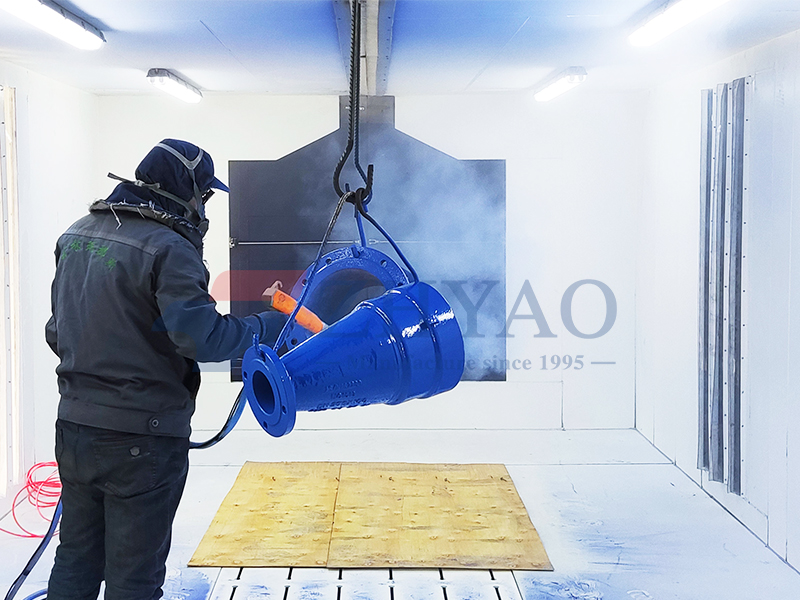
Manual powder coating equipment generally requires a lower initial investment and gives operators considerable control over individual workpieces. It can be suitable for small batches, irregularly shaped products, and factories with changing production schedules.
However, the purchase price is only one part of the operating cost.
When production increases, labor requirements may rise with output. Coating quality can also vary with operator experience, spraying technique, gun distance, and coverage of complex surfaces. Training new operators and maintaining consistent working practices become increasingly important.
Manual spraying may therefore become expensive when a factory needs to process large quantities of similar products every day.
The key question is whether the existing workforce can consistently meet production targets and coating specifications without creating excessive labor costs or quality problems.

2. When Does an Automatic Powder Coating Line Make More Sense?
Automatic powder coating becomes more attractive when products follow repeatable production patterns and the factory needs consistent output over extended operating periods.
Several conditions can indicate that automation deserves serious consideration.
Stable, repetitive production
When a factory coats similar workpieces in large quantities, automatic spray guns and reciprocators can repeat established spraying movements and coverage patterns. This reduces dependence on operators performing every spraying task manually.
Labor has become a production bottleneck
If the factory struggles to recruit experienced spray operators or needs several operators to maintain the required output, automation may reduce the amount of manual spraying required. Workers can instead focus on loading, unloading, inspection, touch-up, and other necessary tasks.
Coating consistency is difficult to maintain
Automatic spraying can improve repeatability when gun positions, spray settings, conveyor speed, and workpiece presentation are properly controlled. However, automation does not automatically guarantee better coating quality. Complex geometries, recessed areas, and changing workpiece orientations may still require manual touch-up or additional spray equipment.
Production demand justifies the equipment investment
A higher-capacity automatic system may be attractive when it can operate at a sufficient utilization rate. If demand is irregular or the line remains idle for long periods, the investment may be difficult to justify even when the equipment has a high theoretical output.
Automation is most valuable when it addresses a clearly identified limitation rather than simply increasing the technical sophistication of the production line.
3. Manual vs. Semi-Automatic vs. Fully Automatic: What Actually Changes?
The choice is not limited to two extremes. Different automation levels allow manufacturers to invest according to their production needs.
Manual powder coating line
Operators perform the primary spraying work, while the equipment provides the necessary powder application and curing functions.
This arrangement is often suitable for low-volume production, frequent product changes, and workpieces that require close operator control. Its main limitations are labor dependence, variable spraying performance, and limited throughput when demand increases.
Semi-automatic powder coating line
A semi-automatic system may use automatic reciprocators for routine spraying while retaining manual guns for complex surfaces, product variations, or touch-up.
This configuration can be effective when the factory produces a mix of standard and irregular workpieces. It reduces repetitive manual work without requiring every spraying operation to be automated.
The actual benefit depends on how much of the production workload can be handled automatically and how frequently operators must intervene.
Fully automatic powder coating line
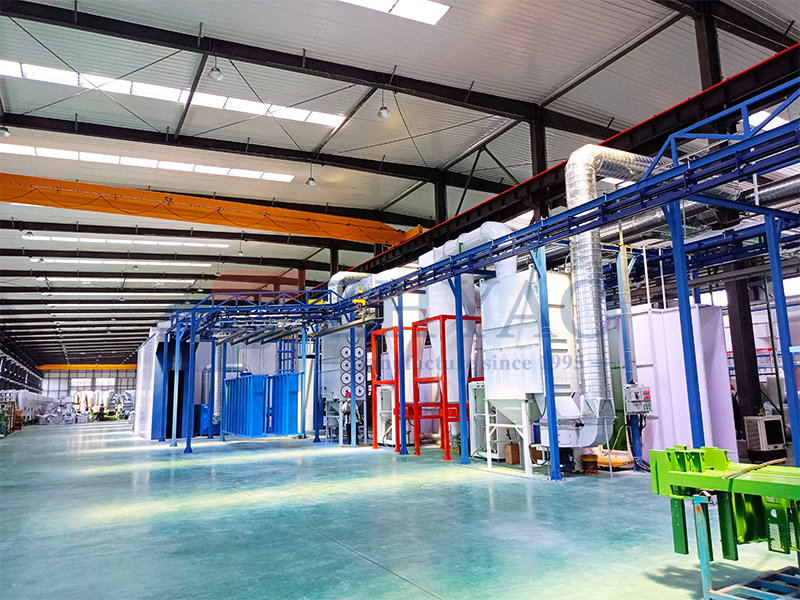
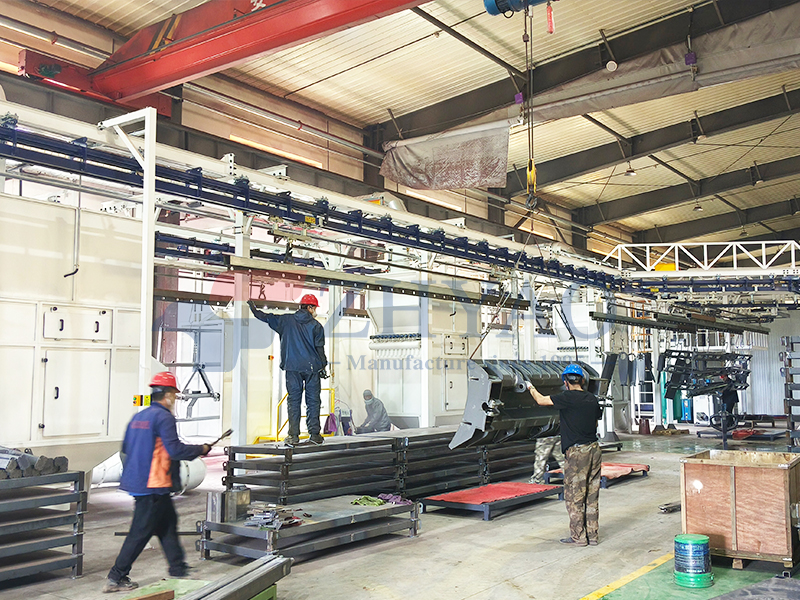
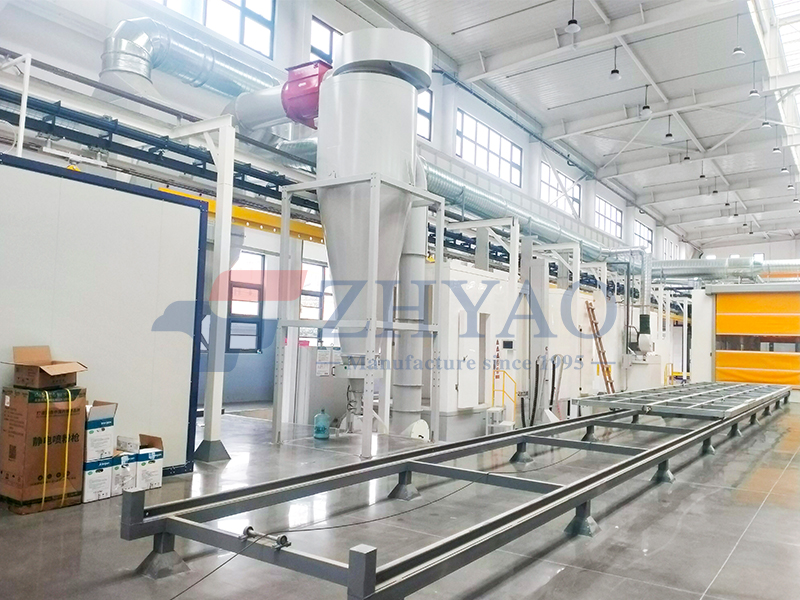
A fully automatic line can integrate automatic conveying, pretreatment, drying, automatic spraying, powder recovery, curing, and coordinated controls. The exact configuration depends on the project.
This approach is generally more suitable for stable, higher-volume production where process stages can operate in a coordinated sequence.
However, the factory must also consider equipment investment, maintenance, process control, changeover requirements, and the consequences of equipment downtime. A highly automated line may create a significant production bottleneck if one critical stage fails.
The right automation level is the one that improves the overall production process, not necessarily the one with the fewest manual operations.
4. Automatic Spray Guns, Reciprocators, or Robots?
Even after deciding to automate, manufacturers must determine which spraying technology fits their products.
Automatic spray guns mounted on reciprocators are often suitable for products with relatively consistent dimensions and repeatable hanging arrangements. The guns move along programmed or configured paths to cover the workpieces as they pass through the booth.
Robotic powder coating systems offer greater flexibility in spray-path movement and can be useful for complex geometries or products requiring different spraying angles. However, they generally involve additional programming, integration, and maintenance considerations.
Manual spray guns can remain valuable alongside either system, particularly for recessed areas, complicated structures, and surfaces that automatic equipment cannot cover effectively.
These technologies are not mutually exclusive. A hybrid arrangement can combine repeatable automatic spraying with manual finishing where necessary.
Before selecting the equipment, evaluate the product geometry, required coating coverage, production rate, and frequency of product changes. Automating a poorly defined spraying process may simply reproduce the same problems at a higher equipment cost.
5. How Should You Evaluate the Cost of Automation?
Comparing equipment quotations alone can lead to the wrong decision. A manual system may cost less initially, but an automatic system may reduce certain labor and production costs over time.
A useful comparison should include both the initial investment and the expected operating costs.
Consider the following factors:
Equipment investment: Spray guns, reciprocators, robots, conveyors, booths, recovery systems, ovens, and controls, depending on the configuration.
Labor requirements: Operators needed for spraying, loading, unloading, inspection, touch-up, and routine maintenance.
Powder consumption: Powder use depends on transfer efficiency, workpiece geometry, coating specifications, overspray recovery, and operating practices.
Quality costs: Rework, rejected parts, inconsistent finishes, and production interruptions.
Maintenance: Spare parts, cleaning, preventive maintenance, technical support, and operator training.
Equipment utilization: Actual production hours, changeover frequency, downtime, and the consistency of order demand.
For example, an automatic line may reduce repetitive spraying labor, but it does not eliminate the need for production staff. Pretreatment, material handling, inspection, maintenance, and manual finishing may still require workers.
Similarly, powder recovery can reduce material waste, but the actual savings depend on the recovery system, powder characteristics, color changes, and operating conditions.
A realistic investment assessment should use the factory's own production data rather than assuming that automation will automatically deliver a particular percentage of savings.
6. When Is a Semi-Automatic Upgrade the Better Choice?
Some factories do not need to replace their entire manual operation to improve productivity.
If the main problem is inconsistent spraying of standard products, adding automatic reciprocators may be sufficient. If manual labor is concentrated in material handling, improvements to the conveyor or loading arrangement may provide more value than installing a spraying robot.
If the bottleneck lies in curing capacity, upgrading the spraying equipment alone may not increase finished output. The curing oven may still determine the maximum production rate.
This is why the first step should be to identify where production is being restricted.
A practical upgrade assessment should answer three questions:
Which operation currently limits finished output or coating quality?
Can targeted automation solve that problem without creating a new bottleneck elsewhere?
Will the expected improvement justify the investment and additional maintenance requirements?
For factories with mixed product ranges or uncertain future demand, a staged upgrade can also reduce investment risk. The existing process can be improved first, followed by additional automation when production requirements justify it.
7. A Practical Decision Framework for Your Factory
Before choosing a manual, semi-automatic, or fully automatic powder coating line, assess your actual production conditions.
Manual equipment may be the better fit when batches are small, product changes are frequent, and current output and quality requirements can be met economically.
Semi-automatic equipment deserves consideration when repetitive spraying consumes substantial labor, but products still require flexibility or manual finishing.
A fully automatic line becomes more attractive when production is relatively stable, workpieces can be presented consistently, output requirements are high enough to support the investment, and the entire process can be coordinated effectively.
No single production volume determines the correct choice for every factory. Two manufacturers producing the same number of parts may need different systems because their workpieces, coating requirements, labor costs, and production schedules differ.
The best investment begins with a clear definition of the current bottleneck and a realistic estimate of future demand. Once these factors are understood, the required automation level becomes much easier to determine.
FAQ
1. Does an automatic powder coating line always produce better coating quality than a manual line?
No. Automatic spraying can improve repeatability for suitable workpieces, but coating quality also depends on pretreatment, grounding, powder characteristics, spray settings, workpiece geometry, and curing conditions. Manual spraying may remain necessary for complex surfaces or finishing operations.
2. Can I upgrade a manual powder coating line to an automatic system later?
In many cases, yes. Depending on the existing equipment, it may be possible to add automatic spray guns, reciprocators, improved conveying equipment, or other automation components. Compatibility with the spray booth, recovery system, workpiece arrangement, and production capacity should be evaluated before selecting an upgrade path.
- Previous:When Should You Invest in an Automatic Powder Coating Line?
- Next:How to Choose an Automatic Pow
-
2026-06-15How Much Does a Powder Coating Line Cost?



 customer service