
- Powder Coating Line ROI Analysis: What Should Manufacturers Calculate Before Investing?
- How to Expand an Existing Powder Coating Line
- How to Plan a New Powder Coating Workshop
- How to Choose the Right Pretreatment System for Your Factory
- How to Design an Industrial Spray Painting Line for Your Factory
phone:+8618533267656
WhatsApp:+8618032661886
Email:info@powder-coatingline.com
Address:No. 55, Airport Road, Changshou Street, Xinle City, Shijiazhuang, Hebei Province
Is Automatic Spraying Equipment Suitable for Mass Production? The Answer Depends on Your Production Goals
Manufacturers continue to improve productivity and product quality, many companies are asking the same question before upgrading their coating process: Is automatic spraying equipment really suitable for batch production?
The answer is yes in many cases—but only when the equipment matches the production requirements. Automatic spraying systems are designed to improve production consistency and efficiency, but the expected benefits depend on product type, production volume, and line configuration. Industries such as automotive parts, metal furniture, agricultural machinery, electrical cabinets, shelving, and construction hardware commonly adopt automated coating systems because they produce large quantities of similar products with repeatable processes.
Stable Production Is More Important Than High Speed
Many people associate automation only with higher speed. In reality, one of its biggest advantages is process stability.
When production relies heavily on manual spraying, coating thickness, spray angle, and gun distance can vary from one operator to another. These differences become more obvious as production volume increases.
Automatic spraying equipment follows programmed parameters throughout the production cycle. The conveyor speed, spray gun movement, and coating process remain consistent, helping reduce variations between production batches. This consistency is often more valuable than simply increasing output.
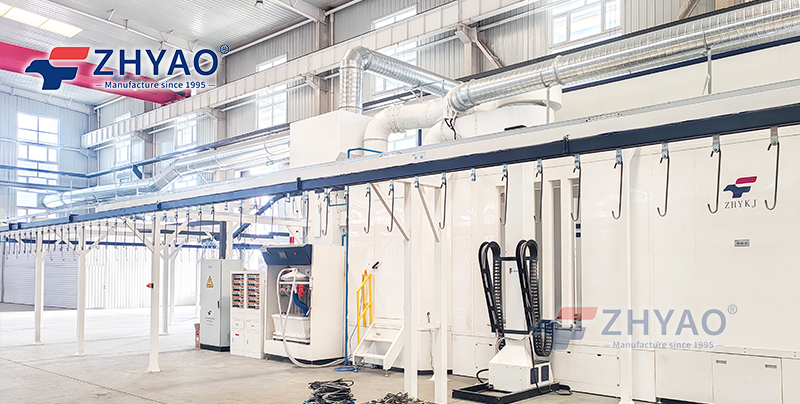
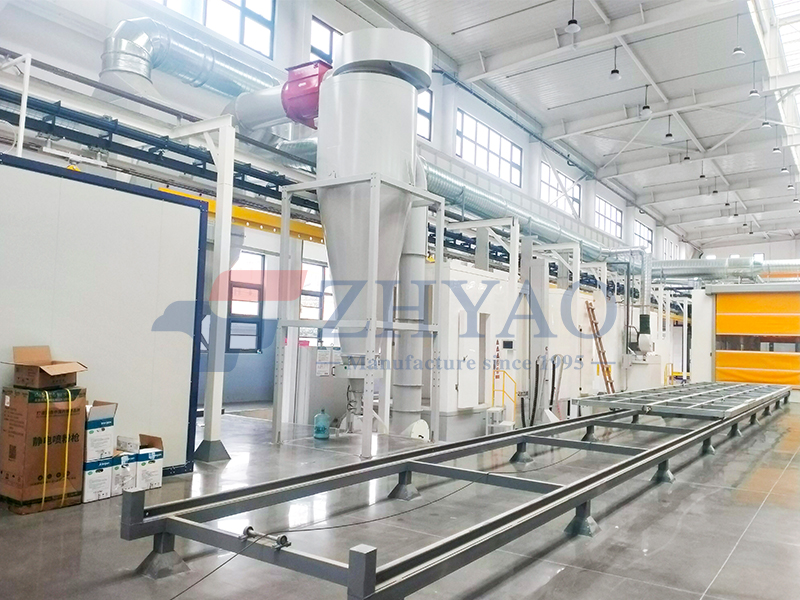
(Powder Coating Line for Distribution Cabinets at Baoding Boyuan Company, China)
Batch Production Benefits from Repeatable Processes
Automatic coating systems perform best when the same or similar workpieces are produced continuously.
Typical applications include:
Metal furniture
Electrical enclosures
Shelving systems
Automotive components
Agricultural machinery parts
Aluminum profiles
Construction hardware
When products share similar dimensions and coating requirements, automated equipment can maintain a steady production rhythm while reducing interruptions caused by manual operation. Continuous production also makes it easier to plan capacity and delivery schedules.
Production Volume Is Only One Part of the Decision
Some manufacturers believe automation only makes sense for very large factories. That is no longer always true.
Modern powder coating lines are available in different levels of automation. Small and medium-sized factories can choose compact systems, semi-automatic solutions, or modular production lines that match current production needs while allowing future expansion. Equipment selection should be based on daily output, product size, available factory space, and expected business growth instead of production volume alone.
Automation Helps Improve Coating Consistency
For batch production, product appearance often needs to remain uniform across hundreds or thousands of parts.
Automatic spraying equipment helps improve consistency by maintaining:
Stable spray distance
Controlled powder output
Repeatable spray paths
Uniform conveyor speed
Consistent curing process when integrated with the production line
These factors contribute to more consistent coating thickness and surface finish, reducing the likelihood of rework caused by uneven spraying.
Labor Challenges Are Driving More Automation Projects
Many manufacturers are facing increasing labor costs and difficulties in recruiting experienced spray operators.
Automatic spraying equipment reduces dependence on manual spraying while allowing operators to focus on equipment monitoring, loading, unloading, and quality inspection. Instead of replacing every manual task, automation changes how labor is allocated throughout the production process.
For factories planning long-term production, this often improves operational stability while reducing fluctuations caused by workforce changes.
Flexible Systems Can Handle More Than One Product
Another common concern is whether automatic equipment can handle different products.
Today's coating lines can be designed with adjustable conveyor systems, programmable spray parameters, and flexible fixtures. When product sizes are similar, production can often switch between different models without major equipment modifications.
For factories producing multiple product families, flexibility during system design is usually as important as production capacity.
Choosing the Right Equipment Matters More Than Choosing Full Automation
Installing the most advanced system does not always deliver the best return.
Before investing in automatic spraying equipment, manufacturers should evaluate:
Daily production capacity
Product dimensions and weight
Coating process requirements
Color change frequency
Available workshop space
Future expansion plans
A coating line designed around actual production requirements usually delivers better long-term performance than a standard solution with unnecessary automation functions.
Final Thoughts
Automatic spraying equipment is well suited for batch production when production processes are stable and equipment is properly matched to manufacturing requirements. Beyond increasing productivity, automation helps improve coating consistency, reduce dependence on manual spraying, and support more predictable production planning.
Rather than asking whether automation is suitable for mass production, manufacturers may benefit more from asking which level of automation best fits their current production goals and future growth plans.
Frequently Asked Questions
1. What production volume justifies automatic spraying equipment?
There is no fixed production quantity. The decision depends on production frequency, product consistency, labor availability, coating quality requirements, and future expansion plans rather than output alone. Modular automatic systems are available for both medium- and large-scale production.
2. Can automatic spraying equipment handle different product sizes?
Yes. Many automated coating systems support adjustable fixtures, programmable spray parameters, and flexible conveyor layouts, allowing manufacturers to process multiple product types with minimal production interruption when the products have similar coating requirements.
- Previous:How Much Does a Complete Powder Coating Line Cost for a Small Factory?
- Next:How to Select a Pretreatment L
-
2026-09-04How to Plan a New Powder Coating Workshop
-
2026-08-31How to Choose a Powder Coating Line



 customer service