
- Powder Coating Line ROI Analysis: What Should Manufacturers Calculate Before Investing?
- How to Expand an Existing Powder Coating Line
- How to Plan a New Powder Coating Workshop
- How to Choose the Right Pretreatment System for Your Factory
- How to Design an Industrial Spray Painting Line for Your Factory
phone:+8618533267656
WhatsApp:+8618032661886
Email:info@powder-coatingline.com
Address:No. 55, Airport Road, Changshou Street, Xinle City, Shijiazhuang, Hebei Province
Pretreatment Line Manufacturer for Complete Powder Coating Solutions
A powder coating line is only as reliable as the surface preparation that precedes it. Yet across many manufacturing facilities, the pretreatment stage remains the most underestimated link in the production chain — until coating adhesion failures, salt spray shortfalls, or rework costs start showing up in monthly quality reports.
As a manufacturer that has delivered complete powder coating solutions to over 60 countries, we routinely encounter the same pattern: buyers invest in advanced spray booths and curing ovens, then pair them with undersized or mismatched pretreatment equipment. The result is a line that looks complete on paper but underperforms in the field.
This article walks through how an integrated pretreatment line is specified, what options are available for different substrates and part geometries, and why selecting a manufacturer that builds both the pretreatment and downstream coating equipment in-house changes the project outcome.
Why Pretreatment Decides Coating Performance
Powder coating adhesion does not happen on bare, contaminated metal. It happens on a clean, chemically activated surface that has been stripped of oils, oxides, and fabrication residues, then conditioned with a conversion coating that bonds with both the substrate and the powder.
Skip that preparation, or execute it poorly, and the powder may still melt and flow in the curing oven — it will even look acceptable to the eye. But the coating will lack the mechanical and chemical bond needed to resist humidity, salt exposure, and thermal cycling. Accelerated weathering tests will expose the gap within hours.
Industry testing frameworks — including ISO 8501-1 for surface cleanliness and the ASTM B117 salt spray protocol — consistently confirm that surface preparation quality correlates directly with coating service life. A well-engineered pretreatment line is not a supplementary purchase. It is the foundation of coating performance.
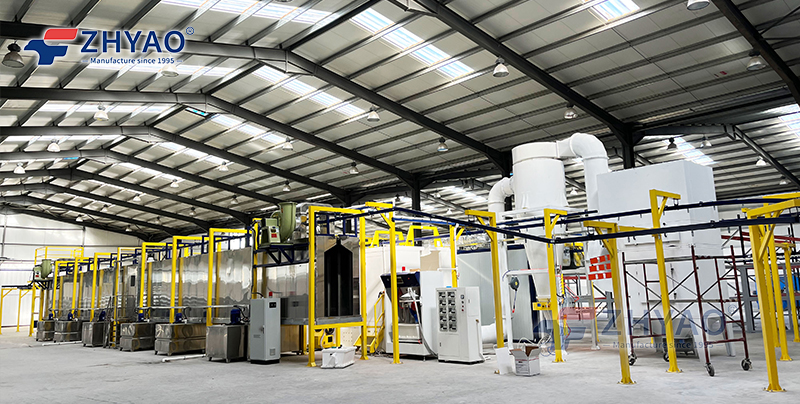
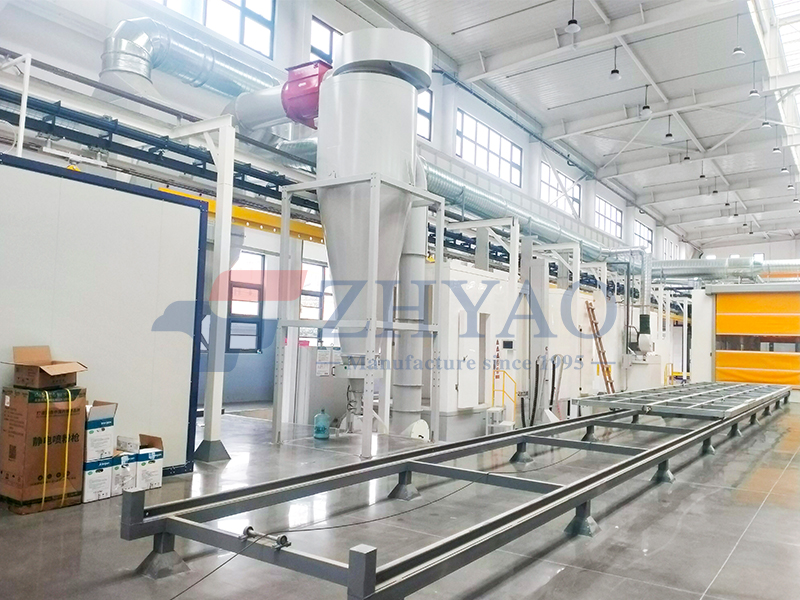
(ZHYAO Algeria Project – Spray Pre-treatment)
Three Pretreatment Technologies, Three Use Cases
No single pretreatment method fits every product mix. The right choice depends on substrate material, part size and geometry, production volume, available floor space, and environmental discharge constraints.
Spray Pretreatment System
In a spray pretreatment line, parts travel through a tunnel where nozzles apply a sequence of chemical stages — pre-degreasing, degreasing, water rinse, surface activation, phosphating or conversion coating, and final rinse — followed by a drying oven.
This configuration suits medium-volume production of parts with moderate geometric complexity: metal furniture components, electrical enclosures, automotive sub-assemblies, and architectural hardware. Typical systems run 3 to 7 process stages, with spray pressures adjustable between 1 and 5 bar and bath temperatures held between 40°C and 80°C depending on the chemistry in use.
Spray tunnels consume less chemical per part than immersion tanks, and they integrate cleanly with overhead conveyor or power-and-free transport systems. They are a common choice when floor space is constrained and throughput targets are in the medium range.
Immersion Pretreatment System
For parts with deep cavities, tubular sections, or complex internal geometries that spray cannot reach consistently, immersion pretreatment is the practical answer. Parts are lowered into a series of process tanks — anywhere from 5 to 12 stations — that cover pre-degreasing, degreasing, rinsing, rust removal, surface activation, phosphating, and final rinse.
Each tank maintains its own temperature (40°C to 90°C, depending on the chemistry), dosing, filtration, and pH monitoring. Transfer between tanks is handled by hoist systems — manual, semi-automatic, or fully programmable depending on the production model.
Immersion lines are widely used for metal furniture, agricultural equipment components, industrial machinery parts, and steel structural elements where full-surface chemical contact is non-negotiable. They handle mixed substrates — carbon steel, galvanized steel, aluminum alloys — within the same line, with chemistry adjustments.
Shot Blasting Pretreatment System
Shot blasting takes a fundamentally different route. Instead of chemical processing, it uses high-velocity abrasive — typically steel shot or grit — propelled by turbine wheels to remove mill scale, rust, and old coatings mechanically.
The process runs dry. There is no chemical wastewater to treat, no phosphating bath to maintain, and no drying stage. Parts emerge with a defined surface profile (commonly Sa 2.0 to Sa 2.5 per ISO 8501-1) that provides excellent mechanical adhesion for powder.
This makes shot blasting the standard choice for heavy steel fabrications: structural steel members, casting and forging components, shipbuilding parts, railway components, and large machinery frames. Systems are configured as hook-type, roller conveyor, or continuous pass-through, with turbine power ranging from 7.5 kW to 30 kW per wheel depending on part size and required throughput.
Why Building the Full Line Matters
A pretreatment line does not operate in isolation. Its throughput must match the powder booth cycle time. Its conveyor interface must align with the curing oven chain. Its drying temperature must be sufficient to leave parts moisture-free before powder application — residual moisture causes pinholes and adhesion defects that only appear after curing.
When pretreatment equipment, spray booths, curing ovens, and conveyor systems are sourced from separate vendors, integration risk falls on the buyer. Interface drawings need to be reconciled. Control logic between PLC systems needs to be coordinated. Drying oven exit temperatures need to match booth entry requirements. When something goes wrong at the pretreatment-to-booth handoff, each vendor points to the other.
Manufacturers that engineer and build the complete line — pretreatment, booth, oven, conveyor, and controls — under one roof eliminate that risk. The interface is designed, not negotiated. The PLC program is written once, for the whole line. Commissioning is done as a system, not stage by stage with gap-filling in between.
Specifying a Pretreatment Line: What Buyers Should Bring to the Table
When a project enters the consultation phase, the information that shapes the pretreatment specification is straightforward but frequently incomplete. Here is what a manufacturer needs to design the right line:
Input | Why It Matters |
Part dimensions and weight range | Determines tunnel opening size, tank volume, conveyor load rating |
Substrate material(s) | Defines chemistry sequence and compatibility |
Current surface condition | Incoming rust, oil, or scale level sets the cleaning intensity |
Required coating standard | Salt spray hours, adhesion grade, and finish spec drive conversion coating choice |
Production volume (parts/hour) | Sizes pumps, heater capacity, and conveyor speed |
Available floor space and height | Constrains layout — inline, U-shape, or multi-level |
Wastewater discharge limits | Determines whether chemical process or dry mechanical process is viable |
Energy sources available | Electric, steam, or gas heating for bath and drying stages |
Without these inputs, any quotation is a guess. With them, a manufacturer can propose a specific stage sequence, tank or tunnel dimensions, chemistry recommendation, and conveyor type — and back it with a production cycle calculation.
Common Specification Mistakes to Avoid
Undersizing the drying stage. A drying oven that is too short or too cool leaves moisture on parts. Powder applied over even trace moisture will blister in the cure oven. The drying stage should be sized with margin, not cut to save floor space.
Mixing chemistries without consultation. Switching from zinc phosphating to a chrome-free conversion coating changes bath temperature, contact time, and rinse requirements. The line must be designed for the intended chemistry from the start.
Ignoring wastewater planning. Chemical pretreatment generates effluent that requires treatment before discharge. Local environmental regulations vary — some regions allow discharge to municipal treatment with pH adjustment, others require on-site treatment plants. This should be part of the project scope, not an afterthought.
Choosing shot blasting for parts that need chemical conversion. Shot blasting produces excellent surface profile for mechanical adhesion but does not deposit a conversion coating. For applications that specify a phosphating or passivation layer — common in automotive and appliance standards — a chemical stage is still required.
From Consultation to Commissioning
A complete pretreatment line project typically follows this path:
- Technical consultation — The buyer provides part data, production targets, coating specifications, and site constraints. The manufacturer reviews requirements and proposes a process flow.
- Process design — Stage sequence, chemistry, temperatures, and contact times are defined. A layout is developed to fit the available space.
- Equipment manufacturing — Tanks, tunnels, pumps, heaters, conveyor, and control panels are built. A typical production cycle runs 45 to 60 days.
- Installation and commissioning — On-site assembly, pipeline connection, chemical charging, PLC programming, and trial runs. The line is tuned to meet the specified coating standard.
- Operator training and handover — Production staff are trained on chemistry maintenance, equipment operation, and troubleshooting. Documentation is handed over.
Choosing a Pretreatment Line Manufacturer
The decision comes down to a few practical questions:
- Does the manufacturer build pretreatment, coating, and curing equipment, or only one segment?
- Can they reference projects with similar substrates and production volumes?
- Do they provide process chemistry guidance, or only the hardware?
- Is installation and commissioning included, or is it handed off to a local contractor?
- What after-sales support is available for chemistry, spare parts, and PLC troubleshooting?
A manufacturer that can answer all five with specific project references — not generic claims — is the one that can take a powder coating project from concept to running production line without the buyer managing integration gaps.
Summary
Pretreatment is where coating quality is determined. The spray booth applies the powder, the curing oven flows it, but the pretreatment line creates the surface that the powder actually bonds to. Selecting the right pretreatment technology — spray, immersion, or shot blasting — depends on the parts, the substrates, the volumes, and the coating standard. And selecting a manufacturer that engineers the complete line, from pretreatment through curing, is what turns a collection of equipment into a production system that performs to specification from day one.
For manufacturers evaluating a new powder coating investment, the pretreatment line deserves the same engineering attention as the spray booth — and the same vendor accountability.【learn more】
-
2026-09-04How to Plan a New Powder Coating Workshop
-
2026-08-31How to Choose a Powder Coating Line



 customer service