
- Powder Coating Line ROI Analysis: What Should Manufacturers Calculate Before Investing?
- How to Expand an Existing Powder Coating Line
- How to Plan a New Powder Coating Workshop
- How to Choose the Right Pretreatment System for Your Factory
- How to Design an Industrial Spray Painting Line for Your Factory
phone:+8618533267656
WhatsApp:+8618032661886
Email:info@powder-coatingline.com
Address:No. 55, Airport Road, Changshou Street, Xinle City, Shijiazhuang, Hebei Province
Conveyor Systems in Powder Coating Lines
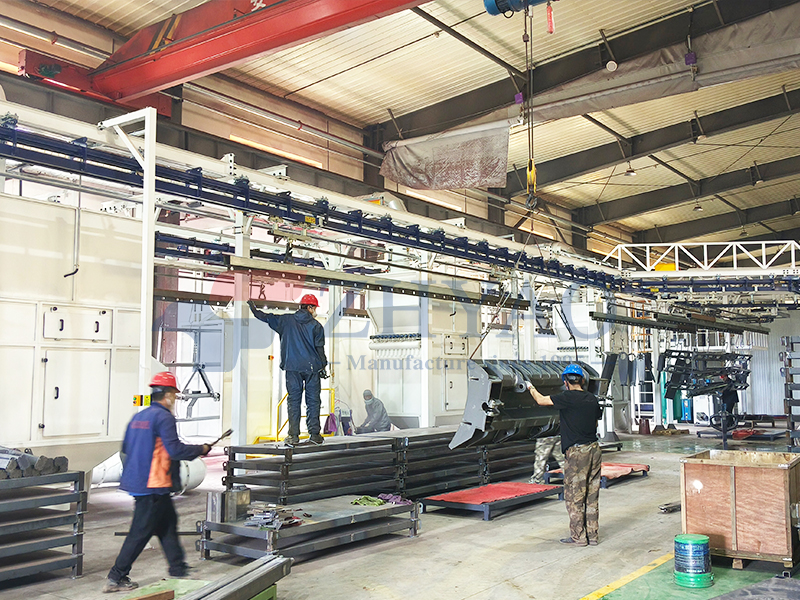
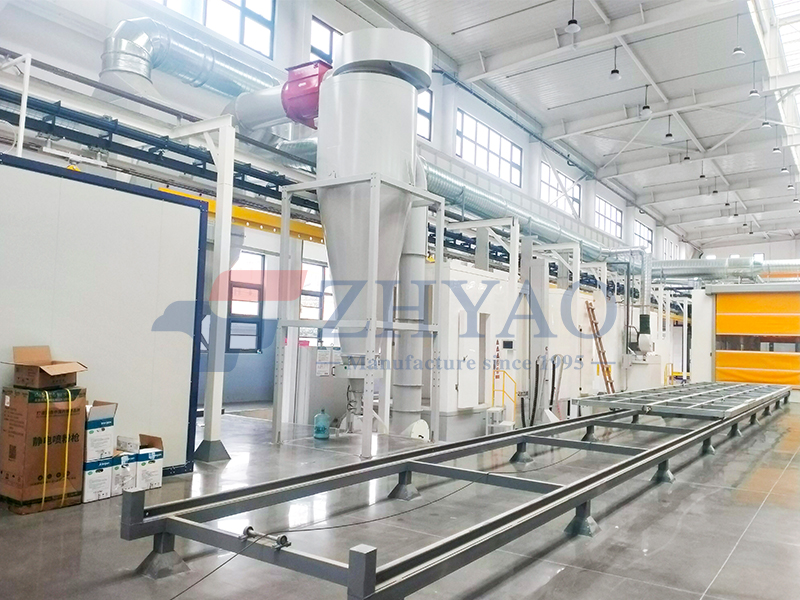
In a powder coating line, the conveyor system is not just a transportation device. It defines how products move through pretreatment, drying, powder application, curing, and cooling.
If the conveyor system is not properly designed, even high-quality coating equipment cannot achieve stable production performance. Many bottlenecks in coating lines are not caused by spraying or curing systems, but by material handling limitations.
For this reason, conveyor design should be considered as early as process planning, not as a secondary equipment decision.
Why Conveyor Systems Are Critical in Powder Coating Lines
The conveyor system directly affects three key aspects of production:
First is production efficiency. The speed and stability of the conveyor determine the overall line capacity.
Second is coating consistency. Irregular movement or unstable spacing between workpieces can lead to uneven coating results.
Third is system integration. Pretreatment, spraying, and curing must all match the conveyor rhythm to maintain balance across the entire process.
A mismatch in any of these areas can reduce overall line performance.
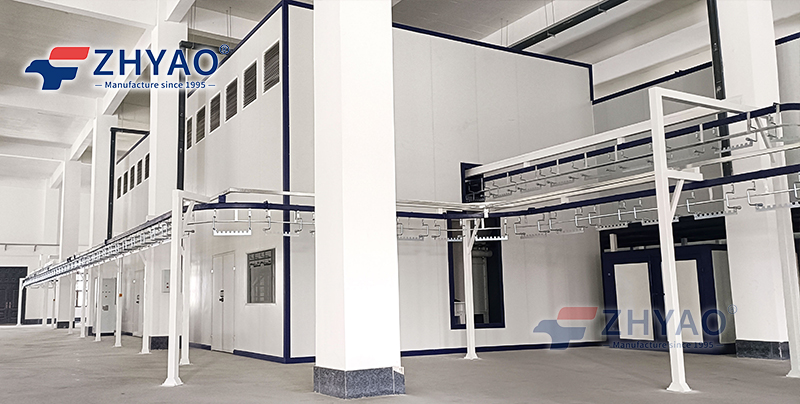
Main Types of Conveyor Systems in Powder Coating Lines
Different production requirements require different conveyor configurations.
Overhead Monorail Conveyor
This is one of the most commonly used systems in powder coating lines.
It is suitable for continuous production environments where products follow a fixed process flow.
Typical applications include:
Metal furniture
Electrical cabinets
General metal fabrication
Advantages include stable operation, efficient space utilization, and compatibility with automatic spraying systems.
Power and Free Conveyor System
This system allows independent movement of workpieces on the same track.
It can stop, accumulate, or bypass sections of the line without interrupting overall production.
It is commonly used in:
Multi-product factories
Complex production scheduling environments
Its flexibility makes it suitable for industries where product variety is high and production flow changes frequently.
Floor Conveyor Systems
Floor-mounted conveyors are used when workpieces are too heavy or too large for overhead systems.
Typical applications include:
Heavy steel structures
Industrial machinery components
Large welded assemblies
This system provides strong load capacity but requires more floor space.
Manual Conveyor Systems
Manual track systems are used in small workshops or low-volume production environments.
They offer flexibility but rely more on labor and manual control.
This type is suitable when production volume is limited and investment budget is relatively low.
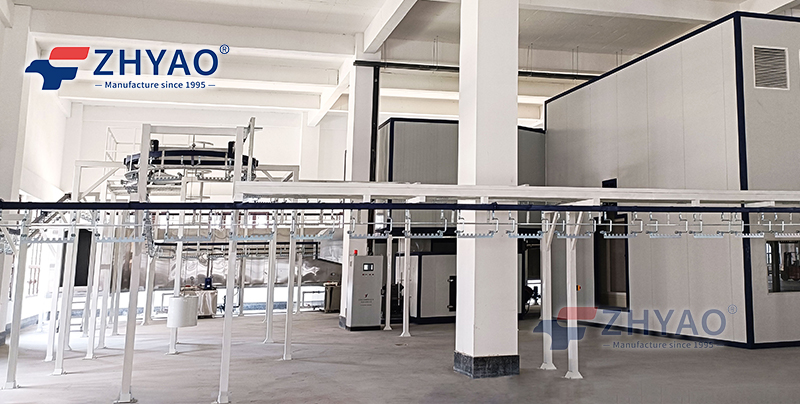
Key Factors in Conveyor System Selection
Product Size and Weight
The physical characteristics of the workpiece determine the structural strength and spacing of the conveyor system.
Heavy or large components require reinforced structures and stable load distribution.
Production Capacity
Higher production volume requires higher conveyor stability and speed consistency.
If conveyor speed is not properly matched with process equipment, bottlenecks will appear in the system.
Factory Layout
Available space and building height directly affect conveyor type selection.
Overhead systems require sufficient vertical clearance, while floor systems require larger horizontal space.
Process Flow Requirements
Different coating processes require different movement patterns.
Some production lines require continuous flow, while others require accumulation and buffering.
Future Expansion
A well-designed conveyor system should allow modification or expansion without replacing the entire line.
This is especially important for manufacturers with expected production growth.
Common Design Mistakes in Conveyor Systems
One common mistake is selecting conveyor type only based on initial investment cost.
Another issue is ignoring production flow balance. Even a high-speed conveyor system cannot improve efficiency if upstream and downstream processes are not synchronized.
A third mistake is copying conveyor designs from other factories without considering differences in product type, space conditions, and production targets.
FAQ
What is the most common conveyor type in powder coating lines?
Overhead monorail conveyors are widely used due to their simplicity and stable operation.
Can one conveyor system handle different products?
Yes, but the system must be designed for product variation in size, weight, and process flow.
What causes bottlenecks in conveyor systems?
Most bottlenecks are caused by mismatched conveyor speed, poor process balancing, or incorrect system design.
Is automation necessary for conveyor systems?
Not always. The level of automation should match production scale and product complexity.
Can conveyor systems be upgraded later?
In many cases, yes. Modular designs allow future expansion or modification.
Conclusion
Conveyor systems play a central role in powder coating line performance. They determine how smoothly products move through each stage of the process and directly influence production efficiency and coating consistency.
A well-designed conveyor system is not just about transporting products. It is about maintaining balance across the entire coating process, ensuring stability from pretreatment to final curing.
Engineering Support from ZHYAO
ZHYAO designs conveyor systems based on product characteristics, production capacity, and factory layout conditions. The goal is to ensure stable material flow, efficient production balance, and scalable system design for future expansion.
- Previous:Powder Coating Line Cost – Engineering Cost Breakdown for Industrial Production Line Investment
- Next:Powder Coating Solutions for F
-
2026-09-04How to Plan a New Powder Coating Workshop
-
2026-08-31How to Choose a Powder Coating Line



 customer service