
- Powder Coating Line ROI Analysis: What Should Manufacturers Calculate Before Investing?
- How to Expand an Existing Powder Coating Line
- How to Plan a New Powder Coating Workshop
- How to Choose the Right Pretreatment System for Your Factory
- How to Design an Industrial Spray Painting Line for Your Factory
phone:+8618533267656
WhatsApp:+8618032661886
Email:info@powder-coatingline.com
Address:No. 55, Airport Road, Changshou Street, Xinle City, Shijiazhuang, Hebei Province
How Powder Coating Equipment Systems Are Structured in Industrial Production Lines
In real production environments, powder coating equipment is never just a single machine. It is a connected system where pretreatment, spraying, curing, and conveying must work in balance. When one section is unstable, the entire coating quality is affected.
This article breaks down the main types of powder coating equipment from a practical engineering perspective, based on how systems actually operate in factories.
1. Pretreatment Systems – Where Coating Performance Is Defined
Pretreatment is the first and most critical stage in any powder coating line. Its function is to prepare the metal surface so that the coating can properly adhere and perform over time.
A typical pretreatment system may include:
Degreasing section
Water rinsing stages
Rust removal or surface activation
Phosphating or conversion coating
Final rinsing
Drying oven
In practice, most coating failures do not originate from spraying itself, but from inconsistencies in pretreatment. Common issues include uneven chemical concentration, insufficient rinsing, or incomplete drying. These lead to adhesion problems, bubbling, or premature coating failure.
2. Powder Coating Booths – More Than a Spray Area
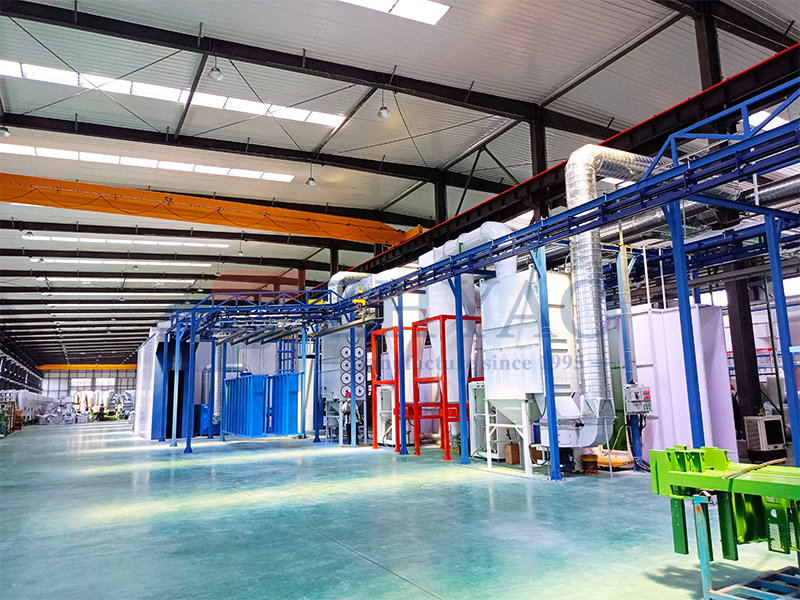
A powder coating booth is often misunderstood as simply a workspace for spraying powder. In reality, it is a controlled airflow system designed to contain overspray and manage powder recovery.
Common booth types include:
Open Booth
Used in small-scale or flexible production environments. Easy to operate, but less stable in powder containment.
Closed Booth
Designed for continuous production. Airflow control is more stable, which improves coating consistency and working conditions.
Cartridge Recovery Booth
Uses filter cartridges to separate and recover oversprayed powder. Suitable for frequent color changes.
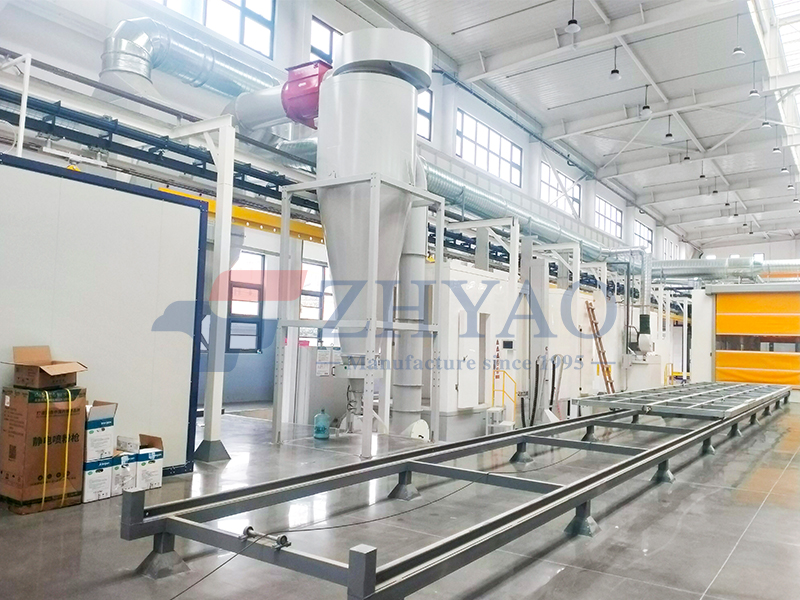
Cyclone Recovery Booth
Uses centrifugal force for high-efficiency powder separation. Common in large-volume single-color production.
The real performance difference between booths is not structure alone, but how stable the airflow and recovery balance remains during long production runs.
3. Spraying Systems – Manual vs Automatic Application
Spraying systems determine coating uniformity and production efficiency.
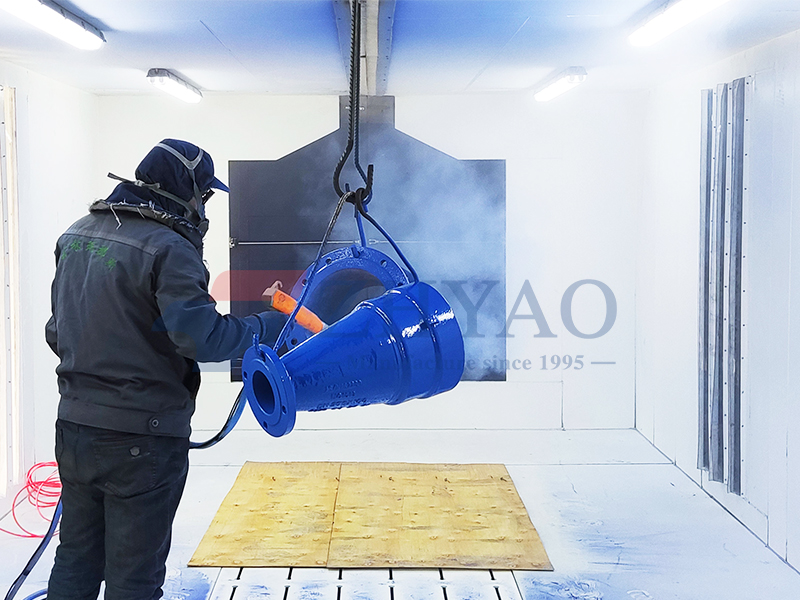
Manual Spraying Systems
Manual coating still plays an important role, especially in:
Complex-shaped parts
Small batch production
Frequent color change operations
Operators control spray distance, voltage settings, and powder output in real time. This allows flexibility, but consistency depends heavily on skill and experience.
Automatic Spraying Systems
Automatic systems use reciprocators or robotic arms to control spray guns with programmed motion paths.
Key advantages include:
Stable film thickness
Repeatable coating results
Integration with conveyor speed
Higher efficiency in mass production
In many modern factories, manual and automatic zones are combined within the same line to balance flexibility and output.
4. Curing Ovens – Where the Coating Becomes a Film
After spraying, the coated parts enter the curing oven, where powder melts, flows, and chemically crosslinks into a durable coating layer.
Main oven types include:
Electric curing ovens
Gas-fired curing ovens
Diesel heating systems (in some regions)
Tunnel curing ovens for continuous lines
The key technical factor is not just temperature setting, but temperature uniformity inside the oven. Differences in airflow or heat distribution can lead to under-curing or over-curing, even when the set temperature appears correct.
In practice, the most stable coatings come from ovens with consistent metal temperature control rather than air temperature control alone.
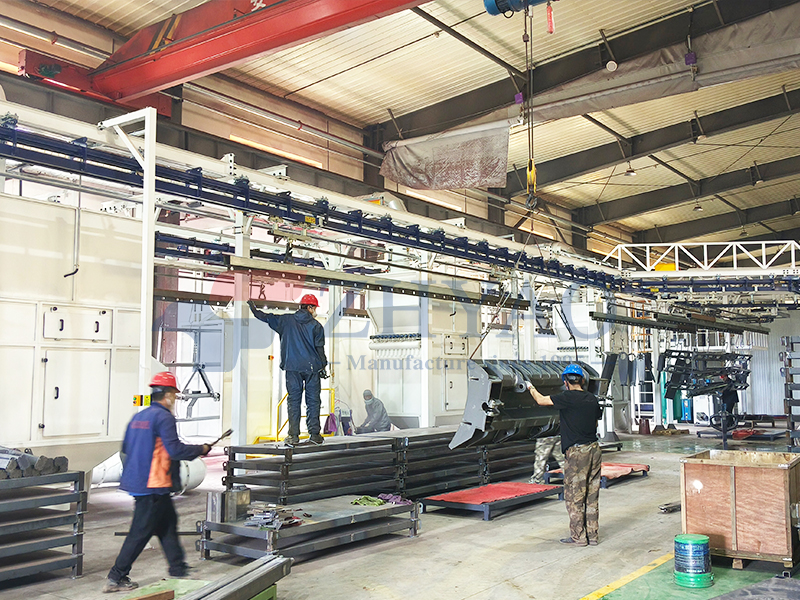
5. Conveyor Systems – The Rhythm of the Entire Line
Conveyor systems connect all coating stages and determine production rhythm.
Common types include:
Overhead chain conveyors
Power & Free systems
Monorail systems
Ground-based transfer systems
The conveyor speed directly affects:
Pretreatment exposure time
Spraying coverage time
Curing dwell time inside the oven
If the conveyor is not properly matched with process requirements, bottlenecks occur quickly—either in coating quality or production flow stability.
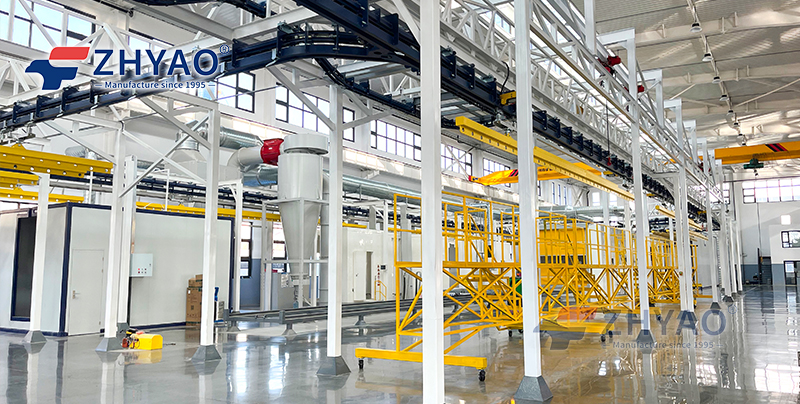
6. Integrated Powder Coating Lines – System Matching Matters Most
A complete powder coating line typically follows this sequence:
Pretreatment → Drying → Powder Coating → Curing → Cooling → Unloading
However, system performance depends less on individual machines and more on how well they are matched together.
Typical mismatch problems include:
Pretreatment capacity lower than production speed
Spraying time too short for full coverage
Oven length insufficient for proper curing
Powder recovery system unable to handle overspray load
In real production, these mismatches are more common than equipment failures.
7. Equipment Selection Logic – Driven by Production Requirements
Selection of powder coating equipment is usually determined by process requirements rather than individual machine specifications.
Key factors include:
Workpiece size and geometry complexity
Daily output requirement
Color change frequency
Coating thickness requirements
Energy consumption constraints
Level of automation expected
Typical application logic:
Small batch, multi-product production → manual + flexible booth system
High-volume standardized parts → automatic spraying + cyclone recovery
Long profiles or continuous parts → tunnel oven + conveyor-based system
The equipment configuration is always a result of production logic, not the starting point.
Conclusion
Powder coating equipment functions as an integrated industrial system rather than independent machines. Pretreatment defines adhesion quality, spraying defines coating uniformity, curing determines final performance, and the conveyor system controls overall production rhythm.
Stable coating quality is achieved when all sections are balanced in capacity and timing. In practical industrial design, system coordination is always more important than the performance of any single machine.
【Learn more】
-
2026-09-04How to Plan a New Powder Coating Workshop
-
2026-08-31How to Choose a Powder Coating Line



 customer service