
- Powder Coating Line ROI Analysis: What Should Manufacturers Calculate Before Investing?
- How to Expand an Existing Powder Coating Line
- How to Plan a New Powder Coating Workshop
- How to Choose the Right Pretreatment System for Your Factory
- How to Design an Industrial Spray Painting Line for Your Factory
phone:+8618533267656
WhatsApp:+8618032661886
Email:info@powder-coatingline.com
Address:No. 55, Airport Road, Changshou Street, Xinle City, Shijiazhuang, Hebei Province
Choosing the Right Conveyor for Powder Coating
When manufacturers invest in a powder coating line, attention is often focused on spray booths, curing ovens, or automatic guns. However, one of the most important decisions is often made much earlier—the choice of conveyor system.
The conveyor is responsible for moving products through every stage of production. If the conveyor is not matched to the product, production capacity, or factory layout, the entire coating line can suffer from bottlenecks, unstable workflow, and unnecessary operating costs.
A conveyor should not be selected simply because it is commonly used in the industry. It should be selected because it fits the actual production requirements of the factory.
Why Different Products Require Different Conveyor Systems
Not all powder coating projects have the same material handling requirements.
A conveyor suitable for lightweight metal furniture may not be suitable for heavy steel fabrications. Likewise, a system designed for continuous mass production may not be the best choice for a factory producing multiple product types in smaller batches.
Before selecting a conveyor, manufacturers should first understand the characteristics of the products being coated.

Recommended Conveyor Solutions for Different Industries
Metal Furniture and Shelving
Metal furniture manufacturers usually require stable and continuous production.
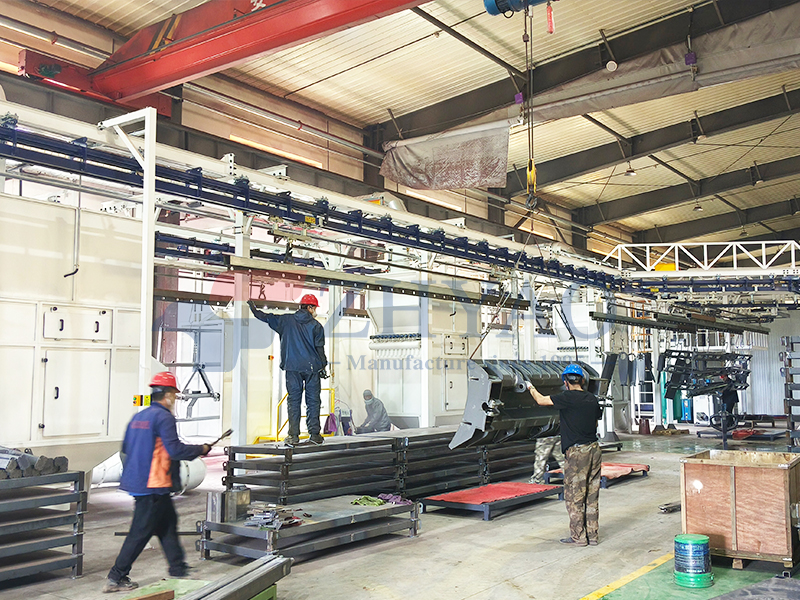
For products such as chairs, tables, cabinets, and storage racks, continuous overhead conveyors are often a practical solution.
Benefits include:
Stable production flow
Efficient use of factory space
Easy integration with automatic spraying systems
Suitable for medium and high production volumes
Electrical Enclosures and Control Cabinets
Electrical cabinets often vary in size and production quantity.
In these situations, both continuous overhead conveyors and power and free conveyors are commonly used.
Power and free systems provide additional flexibility when different products need to be processed on the same line.
Automotive Components
Automotive parts production typically requires consistent throughput and strict process control.
For this type of application, conveyor systems must support stable movement through pretreatment, coating, and curing stages while maintaining production rhythm.
Continuous overhead conveyors and power and free conveyors are frequently used in automotive coating projects.
Aluminum Profiles
Aluminum profile production often involves long workpieces and continuous production schedules.
Conveyor design must consider profile length, hanging methods, and production efficiency.
Overhead conveyor systems are commonly selected because they make efficient use of vertical factory space.
Heavy Steel Structures
Large steel fabrications require different handling methods compared with lightweight products.
When workpieces become extremely large or heavy, floor conveyor systems may be more suitable than overhead conveyors.
The decision is usually based on product weight, dimensions, and loading requirements.
Comparing Common Conveyor Types
Continuous Overhead Conveyor
Suitable for:
Continuous production
Standardized products
Medium to high production volumes
Advantages:
Simple structure
Stable operation
Lower maintenance requirements
Limitations:
Less flexible for mixed production
Power and Free Conveyor
Suitable for:
Multiple product types
Variable production schedules
Flexible manufacturing environments
Advantages:
Product accumulation capability
Flexible routing
Improved production management
Limitations:
Higher investment cost
More complex maintenance
Floor Conveyor System
Suitable for:
Heavy products
Large fabrications
Industrial machinery components

Advantages:
High load capacity
Stable transportation
Limitations:
Occupies more floor space
Manual Track Conveyor
Suitable for:
Small workshops
Low-volume production
Job-shop operations
Advantages:
Lower investment
Flexible operation
Limitations:
Higher labor requirements
Lower production efficiency
Five Factors to Evaluate Before Choosing a Conveyor
Product Dimensions
The size of the workpiece affects hanger spacing, conveyor layout, and equipment dimensions throughout the line.
Product Weight
Conveyor load capacity must match actual production conditions rather than theoretical calculations.
Overloaded systems often experience premature wear and maintenance issues.
Production Capacity
Daily output determines conveyor speed, spacing, and overall system capacity.
A conveyor that is too slow limits production. A conveyor that is too fast may affect coating quality and process stability.
Factory Layout and Building Height
Available floor space and ceiling height often influence conveyor design.
Some factories are ideal for overhead systems, while others may require floor-mounted solutions.
Future Expansion Plans
Production requirements rarely remain unchanged.
Selecting a conveyor system with future expansion in mind can reduce upgrade costs and avoid major modifications later.
Common Conveyor Selection Mistakes
One of the most common mistakes is choosing a conveyor based only on current product dimensions.
As production expands or product types change, the system may quickly become unsuitable.
Another mistake is copying a solution from another factory.
Even if two manufacturers produce similar products, differences in capacity, layout, and workflow can require completely different conveyor designs.
A successful conveyor system is not necessarily the most advanced one. It is the one that fits the production process most effectively.
FAQ
Which conveyor is most commonly used in powder coating lines?
Continuous overhead conveyors are among the most widely used systems because they provide stable operation and integrate easily with powder coating equipment.
Is a power and free conveyor always better?
Not necessarily. It provides greater flexibility but may not be required for every production environment.
Can one conveyor handle multiple products?
Yes, provided the conveyor is designed to accommodate variations in size, weight, and production flow.
Are floor conveyors better for heavy products?
In many heavy-duty applications, floor conveyors offer advantages in load capacity and product handling stability.
Can conveyor systems be expanded later?
Many modern conveyor systems support future expansion, especially when scalability is considered during the initial design stage.
Conclusion
The right conveyor system can improve production efficiency, support coating quality, and simplify future expansion. The wrong choice can create production bottlenecks that affect every stage of the coating process.
Rather than selecting a conveyor based solely on industry trends or equipment cost, manufacturers should evaluate product characteristics, production capacity, factory layout, and long-term business goals.
A conveyor system that matches actual production requirements will often deliver better results than a larger or more complex system that exceeds operational needs.
Engineering Support from ZHYAO
Every powder coating project has unique material handling requirements. Product dimensions, production volume, factory layout, and automation goals all influence conveyor selection.
ZHYAO provides customized conveyor and powder coating line solutions based on actual production conditions, helping manufacturers design efficient transport systems that support stable production and future growth.
- Previous:How to Prevent Powder Waste in Powder Coating Production?
- Next:How to Select a Powder Coating
-
2026-09-04How to Plan a New Powder Coating Workshop
-
2026-08-31How to Choose a Powder Coating Line



 customer service