
- How to Choose the Right Powder Coating Line for Your Products
- Powder Coating Line Cost: New System vs. Upgrading an Existing Line
- How to Select a Pretreatment Line for Powder Coating Systems
- Is Automatic Spraying Equipment Suitable for Mass Production? The Answer Depends on Your Production
- How Much Does a Complete Powder Coating Line Cost for a Small Factory?
phone:+8618533267656
WhatsApp:+8618032661886
Email:info@powder-coatingline.com
Address:No. 55, Airport Road, Changshou Street, Xinle City, Shijiazhuang, Hebei Province
How Cyclone Powder Recovery Works
Introduction
In modern powder coating production, powder recovery systems play a key role in reducing material waste and improving cost efficiency. Among different recovery technologies, the cyclone powder recovery system is one of the most widely used solutions in industrial powder coating lines.
Understanding how cyclone powder recovery works is essential for optimizing powder utilization, maintaining stable spray performance, and ensuring consistent coating quality.
As an important part of industrial systems designed by manufacturers such as ZHYAO, cyclone recovery technology is valued for its simplicity, efficiency, and continuous operation capability.
1. What Is a Cyclone Powder Recovery System?
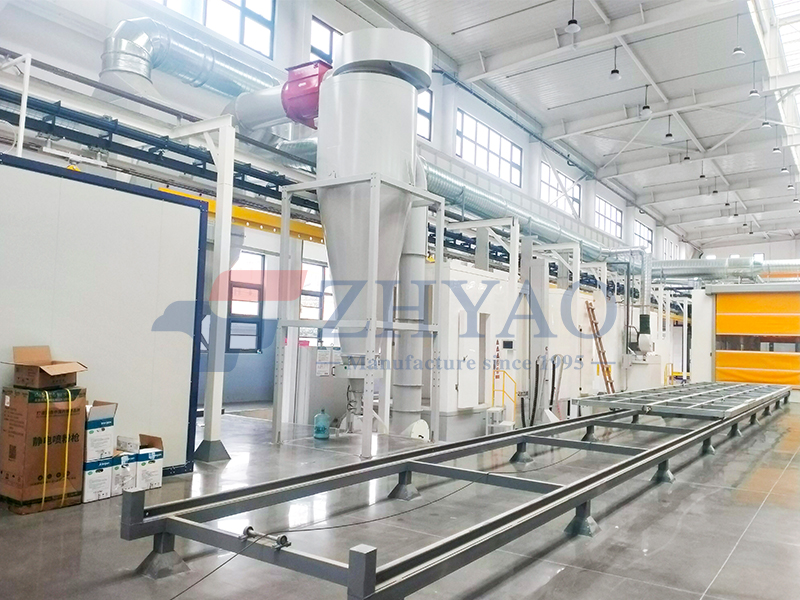
A cyclone powder recovery system is a mechanical separation device used to separate powder particles from airflow using centrifugal force.
Its main functions include:
Collecting oversprayed powder from spray booths
Separating powder from air using rotational airflow
Recycling usable powder back into the system
Discharging clean air safely
This system is widely used in medium and large-scale powder coating lines.
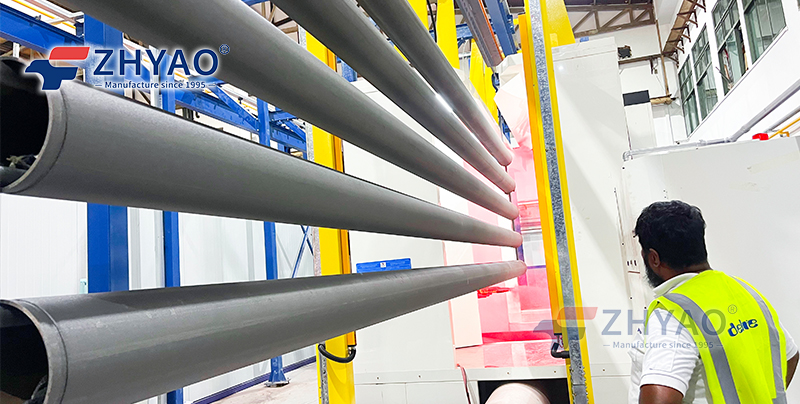
2. Basic Working Principle of Cyclone Powder Recovery
The working principle is based on centrifugal separation.
The process works as follows:
Powder overspray is carried by airflow from the spray booth
The mixed air enters the cyclone chamber tangentially
High-speed rotating airflow is created inside the cyclone
Centrifugal force pushes heavier powder particles toward the wall
Powder particles lose velocity and fall downward into a collection hopper
Clean air moves upward and exits through the top outlet
This continuous separation process allows efficient powder recovery without complex moving parts.
3. Key Components of a Cyclone System
3.1 Cyclone Body
The main chamber where air and powder separation occurs. Its cone-shaped structure is critical for creating stable vortex airflow.
3.2 Inlet Duct
The tangential inlet introduces powder-laden air into the cyclone, generating rotational motion.
3.3 Collection Hopper
Separated powder falls into the hopper for reuse or further screening.
3.4 Air Outlet
Cleaned air exits from the top after powder separation, often directed to secondary filtration systems.
4. Secondary Filtration in Cyclone Systems
Although cyclone separators remove most powder particles, fine particles may still remain in the air.
Therefore, many systems include:
Cartridge filters
Bag filters
Final air exhaust systems
This ensures environmental compliance and minimizes powder loss.
5. Advantages of Cyclone Powder Recovery Systems
5.1 High Recovery Efficiency
Cyclone systems can recover a large percentage of oversprayed powder under stable conditions.
5.2 Continuous Operation
No moving mechanical parts inside the cyclone body allows continuous and stable operation.
5.3 Low Maintenance
Compared to complex filtration systems, cyclone separators require minimal maintenance.
5.4 Cost-Effective Design
Simple structure makes it suitable for industrial-scale powder coating lines.
6. Limitations of Cyclone Recovery Systems
Despite advantages, cyclone systems also have limitations:
Lower efficiency for ultra-fine powder particles
Performance depends on stable airflow conditions
Sensitive to improper system design or imbalance
Not ideal for very small-scale or high-precision color change applications
In many cases, cyclone systems are combined with filter systems for better performance.
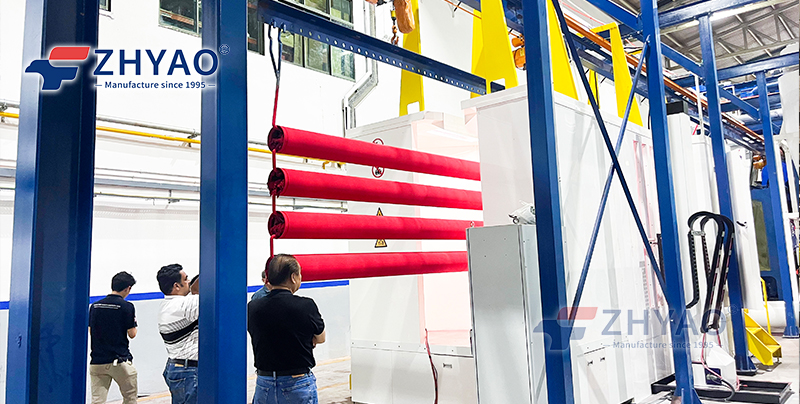
7. Key Factors Affecting Performance
The efficiency of cyclone powder recovery depends on:
Airflow speed and stability
Cyclone chamber design and dimensions
Powder particle size distribution
Spray booth pressure balance
System layout and duct design
Maintenance of downstream filtration units
Even small design deviations can affect recovery efficiency significantly.
8. Industrial Application in Powder Coating Lines
Cyclone recovery systems are commonly used in:
Metal furniture coating lines
Automotive component coating systems
Industrial equipment finishing
Large-scale continuous production lines
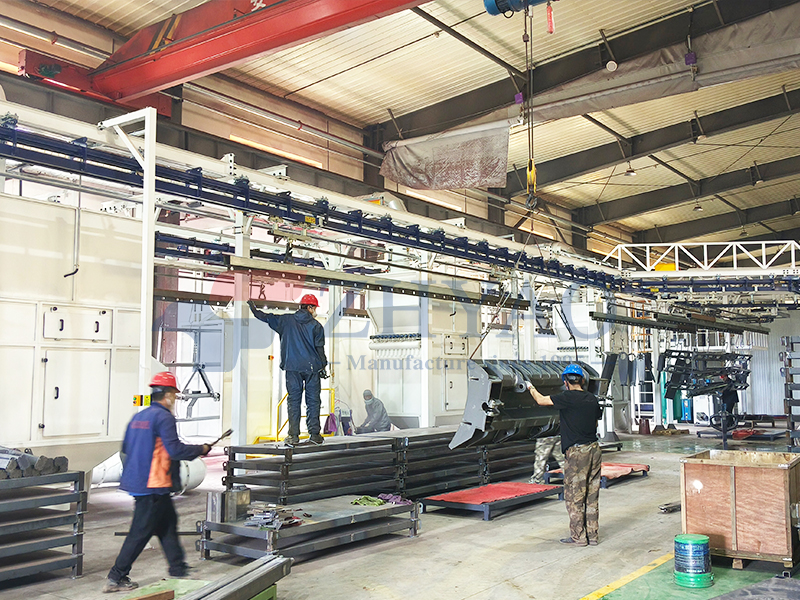
In systems designed by ZHYAO, cyclone recovery is often integrated with automatic spray booths and conveyorized production lines to ensure stable, high-efficiency powder reuse.
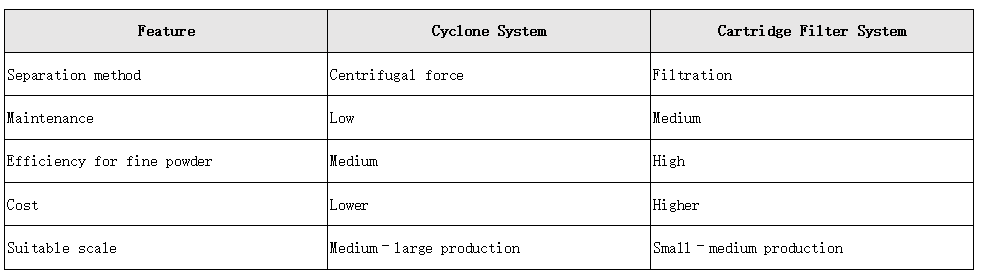
9. Cyclone vs Cartridge Filter Recovery Systems
Conclusion
The cyclone powder recovery system works by using centrifugal force to separate powder particles from airflow, allowing efficient recycling of oversprayed powder in industrial coating processes.
Its simple structure, continuous operation, and cost efficiency make it a widely used solution in modern powder coating lines. However, its performance depends heavily on airflow design and system integration.
In well-engineered systems such as those designed by ZHYAO, cyclone recovery units are integrated into complete powder coating lines to ensure stable powder utilization, reduced waste, and improved production efficiency.
-
2026-06-15How Much Does a Powder Coating Line Cost?
-
2026-06-11What Size Powder Coating Booth Do You Need?
-
2026-06-11How Does a Powder Coating Oven Work?
-
2026-06-03How Cyclone Powder Recovery Works



 customer service