
- How to Choose the Right Powder Coating Line for Your Products
- Powder Coating Line Cost: New System vs. Upgrading an Existing Line
- How to Select a Pretreatment Line for Powder Coating Systems
- Is Automatic Spraying Equipment Suitable for Mass Production? The Answer Depends on Your Production
- How Much Does a Complete Powder Coating Line Cost for a Small Factory?
phone:+8618533267656
WhatsApp:+8618032661886
Email:info@powder-coatingline.com
Address:No. 55, Airport Road, Changshou Street, Xinle City, Shijiazhuang, Hebei Province
Why Is Powder Coating Not Sticking?
Introduction
Poor adhesion in powder coating systems is a frequent production issue that directly affects coating durability, corrosion resistance, and surface appearance. When powder coating is not sticking, the root cause is usually not a single defect but a combination of surface preparation, electrostatic performance, and process stability.
In industrial powder coating lines, adhesion failure often appears as peeling, flaking, or weak bonding after curing. Understanding why powder coating is not sticking is essential for stabilizing product quality and reducing rework.
1. Main Reasons Why Powder Coating Is Not Sticking
Adhesion failure typically originates from the following factors:
1.1 Inadequate surface pre-treatment
If oil, rust, dust, or oxide layers remain on the substrate, the powder cannot properly bond. This is one of the most common causes of poor adhesion.
1.2 Poor grounding of workpieces
Powder coating relies on electrostatic attraction. If the workpiece is not properly grounded, powder transfer efficiency drops significantly, leading to weak coating adhesion.
1.3 Incorrect curing conditions
If curing temperature is too low or time is insufficient, the powder cannot fully melt and crosslink, resulting in weak bonding to the substrate.
1.4 Improper spray parameters
Incorrect voltage, air pressure, or spray distance can lead to uneven powder deposition and poor film formation.
1.5 Contaminated compressed air
Moisture or oil in the air supply system can interfere with powder flow and reduce coating adhesion performance.
2. Process Chain Factors Affecting Adhesion
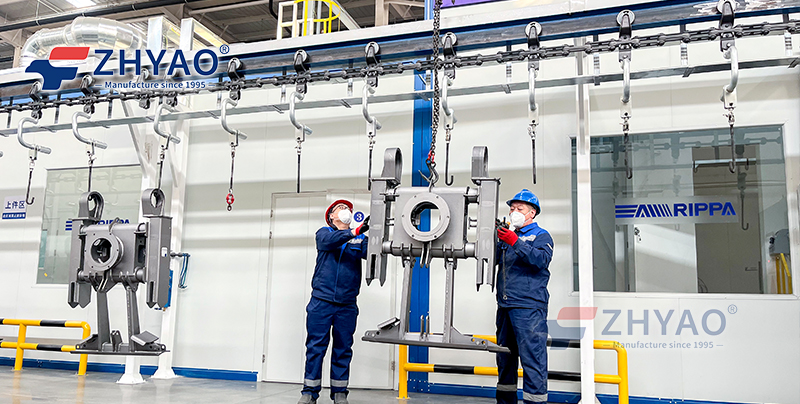
Powder coating adhesion is not only determined in the spray booth. It is influenced by the entire production line:
Pre-treatment system: degreasing, rinsing, and conversion coating quality directly determine surface energy
Drying stage: residual moisture can cause blistering or weak bonding
Spray environment: airflow and powder cloud stability affect deposition efficiency
Curing oven performance: temperature uniformity determines final crosslinking quality
Even small deviations in any stage can cause noticeable adhesion problems.
3. Technical Solutions to Improve Adhesion
3.1 Strengthen pre-treatment process control
Ensure complete oil removal, rust cleaning, and proper chemical conversion coating to improve surface bonding capability.
3.2 Improve grounding system
Use reliable grounding clamps and regularly check resistance to ensure stable electrostatic performance.
3.3 Optimize curing parameters
Maintain stable curing temperature and time according to powder specifications to ensure full polymerization.
3.4 Stabilize compressed air quality
Install proper filtration and drying systems to prevent oil and moisture contamination.
3.5 Adjust spray system settings
Optimize voltage, powder flow rate, and spray distance based on workpiece geometry.
4. Equipment-Level Optimization Suggestions
For long-term stability, adhesion issues should be addressed from a system perspective:
Upgrade pre-treatment line consistency for uniform surface activation
Ensure oven temperature balance across all zones
Improve powder recycling ratio control to avoid contamination buildup
Use automated spray control systems for consistent application
Maintain stable conveyor speed synchronization across the entire line
A well-integrated powder coating line significantly reduces adhesion-related defects.
5. Practical Troubleshooting Checklist
Operators can quickly check the following points:
Surface is fully degreased and dried before coating
Grounding resistance is within acceptable range
Compressed air is free from oil and moisture
Spray voltage and distance are stable
Curing temperature matches powder specifications
Conveyor speed is consistent during production
Conclusion
Poor adhesion in powder coating systems is usually the result of multiple interacting factors rather than a single failure point. By improving surface preparation, electrostatic grounding, spray control, and curing consistency, manufacturers can significantly enhance coating bonding performance.
If adhesion issues persist, a full line evaluation is often required to identify hidden process instability in the powder coating system.
-
2026-06-15How Much Does a Powder Coating Line Cost?
-
2026-06-11What Size Powder Coating Booth Do You Need?
-
2026-06-11How Does a Powder Coating Oven Work?
-
2026-06-03How Cyclone Powder Recovery Works



 customer service